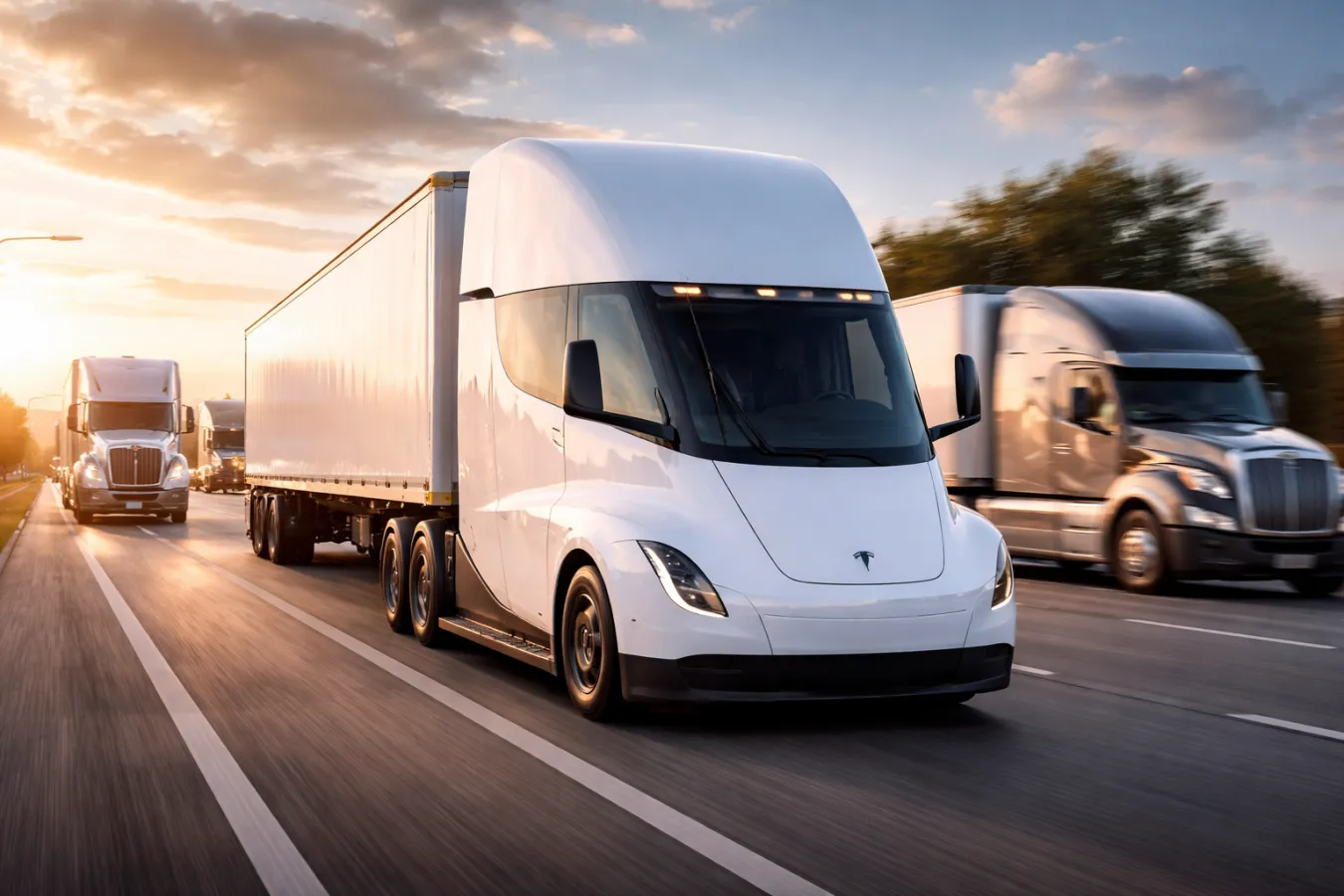
Tesla Semi Hits the Road at the Worst Time
After years of talk, teaser videos and repeated delays, Tesla’s Semi is finally beginning to hit the road. For electric-vehicle enthusiasts and clean-transportation advocates, this milestone represents a long-awaited shift in the trucking industry. But while the truck’s debut feels like a breakthrough on paper, the timing could hardly be more challenging. With economic uncertainty, fluctuating fuel prices, infrastructure shortcomings and tightening fleet budgets, Tesla faces significant headwinds just as the Semi enters commercial reality.
Below, we explore why the Semi’s launch matters, the hurdles it faces and what this moment might mean for the future of heavy-duty electrification.
A Long Road to Production
Tesla first announced plans for an electric Class 8 semi-truck years ago, promising revolutionary range, massive cost savings and a step change in commercial transportation. Across multiple high-profile unveilings, the company showcased futuristic designs and bold performance numbers.
Yet between initial announcements and road readiness, the Semi’s journey was marked by delays. Supply-chain disruptions, battery manufacturing constraints and shifts in Tesla’s production priorities all pushed back timelines. Many in the trucking industry began to wonder whether the Semi would ever reach market in meaningful volume.
Now, as the first units roll out to customers, that question has been answered — at least in part. Tesla’s Semi is no longer just a prototype; it’s a truck that will haul freight on real highways and face the daily rigors of commercial operation.
What the Semi Promises
At its core, the Semi aims to transform heavy trucking by replacing internal-combustion diesel power with an all-electric drivetrain. Tesla has marketed the truck on several key benefits:
Lower operational costs: Electricity can be significantly cheaper per mile than diesel, especially when charged during off-peak hours or paired with renewable sources.
Reduced maintenance: Fewer moving parts than a diesel engine means less routine service — translating into lower downtime and repair costs.
Instant torque: Electric motors deliver rapid acceleration and strong hill-climbing ability, a useful feature for heavily loaded trucks.
Driver comfort: Lower noise, reduced vibration and high tech cockpits can improve the driver experience.
In theory, these advantages can add up to a compelling business case for fleets — especially for predictable regional routes where depot charging and route planning are straightforward.
The Ironic Timing
Despite these benefits, the Semi arrives at a moment rife with challenges that could slow or complicate adoption.
1. Economic Uncertainty
Operators are tightening budgets. Interest rates remain elevated and fleet capital expenditures are being scrutinized more carefully than in recent years. Buying new equipment, especially high-cost electric trucks, requires confidence in return on investment.
Many fleets remain hesitant to commit substantial funds to cutting-edge technology until economic signals stabilize — particularly when conventional diesel fleets are still serviceable and familiar.
2. Charging Infrastructure Gaps
Electric passenger vehicles are increasingly common and charging networks for cars continue to expand. But heavy-duty charging infrastructure is still in its infancy.
Charging a Class 8 truck requires high-power systems, substantial electrical capacity and careful site planning. Many depots and truck stops simply don’t yet have the infrastructure to support frequent, high-speed charging.
This means that operators who want to adopt the Semi also need to plan and invest in charging — a non-trivial undertaking in both cost and logistics.
3. Fuel Price Flux
Diesel prices have been volatile, fluctuating with global supply shocks, economic shifts and policy changes. While high diesel prices make electric alternatives more attractive, unpredictable swings make long-term planning harder.
Fleets calculating total cost of ownership need stable assumptions. When fuel costs jump and fall rapidly, forecasting savings from electrification becomes more difficult.
Competing in a Crowded Field
Tesla isn’t the only company pursuing electric semi-trucks. Across the industry, established truck builders and startups alike have announced or launched electric heavy-duty models.
Traditional manufacturers bring decades of experience, existing service networks and dealer familiarity — all strengths when it comes to convincing fleets to make a big investment.
In contrast, Tesla’s sales and service infrastructure for commercial vehicles is still developing. While passenger EV sales benefit from Tesla’s retail footprints and brand awareness, selling million-dollar trucks into the conservative world of fleet purchasing is a different proposition.
Realities on the Ground
Early adopters of the Tesla Semi will be under intense scrutiny. How the trucks perform in real-world duty cycles will influence broader industry confidence.
Key questions fleets are likely to evaluate include:
Range consistency: Does the Semi reliably meet advertised miles on a single charge?
Charging reliability: Are charging stations dependable, available and fast enough to fit commercial schedules?
Total cost of ownership: When all costs are tallied — purchase price, electricity, maintenance and financing — does the Semi make financial sense?
Driver acceptance: Do drivers like working with the truck day after day?
Even if early feedback is positive, these are high bars to clear — especially for a vehicle that represents a technological leap relative to diesel incumbents.
Why It Still Matters
Despite the headwinds, the Semi’s arrival is a landmark. It symbolizes a belief — shared by policymakers, manufacturers and many fleet operators — that transportation will electrify over time.
Every new technology must pass through stages: conceptual excitement, real-world proof points and eventually widespread adoption. The Semi entering service moves the electric truck conversation from concept toward performance.
Even if adoption is initially slow, the learning that comes from early deployments will be valuable. Fleets will gather data on uptime, charging behavior, maintenance needs and duty cycle matching — all elements that inform future buying decisions.
Additionally, the Semi’s presence in the market pushes infrastructure development. Charging providers, grid planners and policymakers all take cues from real vehicle deployments. The more electric trucks on the road, the stronger the business case for investment in necessary charging networks.
The Policy Factor
Government incentives and regulations also play a role. Programs that subsidize electric truck purchases or support charging infrastructure can make the economics easier for fleets. Similarly, emissions regulations and future fuel standards create pressure for cleaner alternatives.
Tesla’s Semi launch intersects with these policy dynamics. In regions with strong support for decarbonization, fleets may be more inclined to explore electrification. Conversely, in markets without incentives, the up-front cost remains a significant barrier.
Not a One-Size-Fits-All Solution
Importantly, electric semis are not expected to instantly displace diesel trucks across every application. Certain use cases — such as long-haul cross-country routes with limited charging access — remain difficult to electrify today.
Instead, early traction is more likely in predictable, return-to-base operations such as regional delivery, port drayage and short-haul logistics where charging can be managed efficiently.
For many fleets, that incremental approach is a sensible path to electrification: start in areas where the business case is strongest, learn from real experience and expand over time.
The Road Ahead
Tesla’s Semi has arrived at a moment of contradiction: a breakthrough technology entering a market that is cautious and uncertain. Yet this timing may also yield valuable insights. Technology doesn’t need perfect conditions to advance — it needs real deployments, real feedback and real learning.
The challenges facing the Semi’s adoption are not unique to Tesla. Every company pushing heavy-duty electrification faces infrastructure gaps, economic variables and operational questions. The difference today is that electric trucks are no longer theoretical. They are trucks that will carry freight on America’s highways.
For fleets, regulators and charging providers alike, the Semi’s launch offers a real beginning — not the end — of a transition. How quickly that transition unfolds will depend on broader economic forces, infrastructure investment and the ability of electric trucks to deliver value in hard-nosed commercial settings.
In the end, the timing may be rough, but the milestone itself cannot be ignored. The Semi is finally on the road — and its impact will grow as the industry visibly grapples with this new chapter in trucking history.

 Facebook
 Twitter
 Whatsapp
 Linkedin