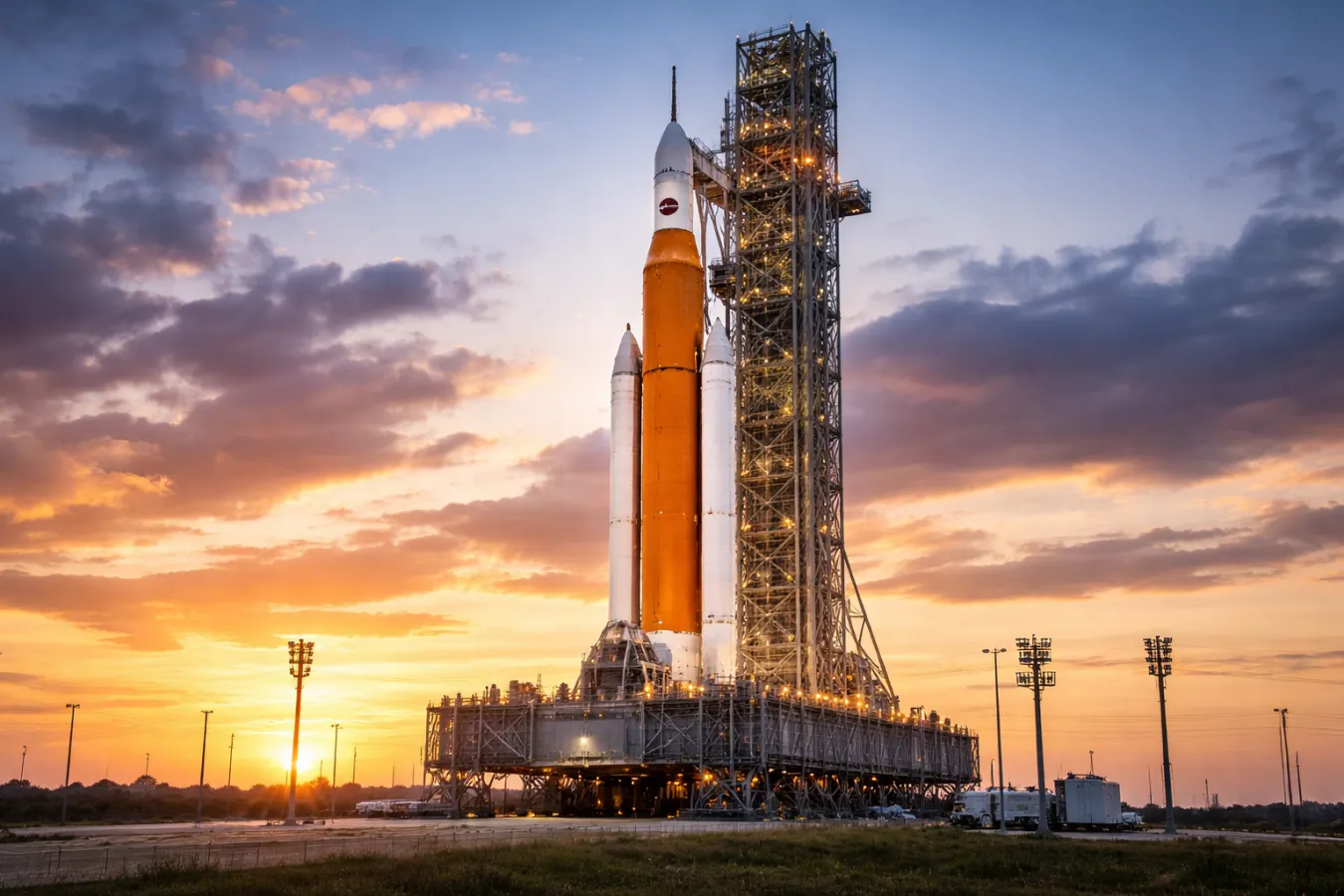
Artemis 2 Launch Delay: When Will NASA Fly?
The countdown to humanity’s next great leap toward the Moon has slowed — but not stopped. NASA has officially delayed the launch of Artemis 2, pushing the historic mission back by at least one month from its previously expected timeframe. The decision has sparked widespread curiosity: When will Artemis 2 actually launch and why was the delay necessary?
The short answer is that Artemis 2 is now expected to launch no earlier than March 2026, with final timing dependent on testing results and launch window availability. The longer answer involves complex engineering challenges, safety considerations and the realities of flying astronauts beyond low Earth orbit for the first time in more than 50 years.
What Is Artemis 2 and Why It’s So Important
Artemis 2 is a cornerstone mission in NASA’s ambitious Artemis program, which aims to return humans to the Moon and establish a long-term lunar presence. Unlike Artemis 1, which flew uncrewed in 2022, Artemis 2 will carry four astronauts aboard the Orion spacecraft for a lunar flyby mission.
This will be the first crewed mission to travel to the Moon since Apollo 17 in 1972. While Artemis 2 will not land on the lunar surface, it will send astronauts farther from Earth than any human mission in decades, testing life-support systems, navigation, communications and crew operations in deep space.
In simple terms, Artemis 2 is the final dress rehearsal before NASA attempts a lunar landing mission with Artemis 3.
When Was Artemis 2 Originally Supposed to Launch?
NASA had been targeting an early February 2026 launch window for Artemis 2. That schedule was based on months of integrated testing involving the Space Launch System (SLS) rocket, Orion spacecraft and ground systems at Kennedy Space Center in Florida.
Because Moon missions rely on precise orbital mechanics, launch opportunities are limited to specific windows each month. Missing one window often means waiting weeks for the next opportunity — which is exactly what happened here.
Why NASA Delayed Artemis 2 by at Least a Month
NASA’s decision to delay the mission wasn’t caused by a single issue, but by a combination of technical findings and external conditions that emerged during final preparations.
1. A Hydrogen Leak Discovered During Critical Testing
One of the biggest factors behind the delay was a liquid hydrogen leak discovered during a key prelaunch test known as a wet dress rehearsal. This test involves fully fueling the SLS rocket and running through the countdown sequence without actually launching.
Liquid hydrogen is extremely volatile and must be handled with absolute precision. Even a small leak can pose safety risks and compromise mission reliability. Engineers determined that the issue required further inspection, repairs and validation testing before astronauts could safely board the rocket.
Because Artemis 2 is a crewed mission, NASA applies far stricter safety margins than it would for an uncrewed launch.
2. Unfavorable Weather at the Launch Site
Unusual weather conditions also played a role. Cold temperatures and high winds affected launch preparations and limited the number of days available for testing. Certain fueling operations and system checks cannot be performed safely outside specific temperature and wind limits.
These weather delays compressed the already tight February launch window, leaving NASA with insufficient time to complete testing, analyze data and confidently clear the vehicle for flight.
3. Safety Over Schedule — A Deliberate Choice
NASA leadership ultimately decided that attempting to “rush†the launch would introduce unnecessary risk. Human spaceflight demands caution, especially for a mission venturing far beyond Earth orbit with a brand-new combination of systems.
The agency has emphasized that Artemis 2 is not a race — it is a foundation mission. Any unresolved issue on the ground is far easier to fix than a problem encountered in deep space.
So, When Will Artemis 2 Launch Now?
With the February window ruled out, NASA is now targeting March 2026 at the earliest. Several launch opportunities exist throughout March, depending on how quickly engineers resolve outstanding issues and complete final verification tests.
If additional delays occur, later spring windows are also possible. NASA has not announced a firm launch date yet, preferring to wait until all systems are fully cleared and mission readiness reviews are complete.
In spaceflight, especially with crewed missions, “no earlier than†dates are common — and they’re intentionally conservative.
What Still Needs to Be Done Before Launch
Before Artemis 2 can fly, NASA teams must complete several key steps:
Fully resolve the hydrogen leak and verify repairs
Possibly repeat portions of the wet dress rehearsal
Conduct final integrated system tests
Review data through multiple safety and readiness boards
Confirm favorable weather conditions during the launch window
Only after all of these steps are completed will NASA formally set a launch date.
Why Delays Like This Are Normal in Human Spaceflight
To the public, a month-long delay may feel significant. In the context of space exploration, it’s relatively modest — especially for a mission of this complexity.
Artemis 2 combines:
The most powerful rocket ever built
A new deep-space spacecraft
Modern life-support systems
Human crews traveling beyond Earth’s protective magnetic field
Historically, nearly every major human spaceflight program — from Apollo to Space Shuttle to modern commercial crew missions — experienced delays during final preparations.
NASA’s philosophy is clear: find problems on the ground, not in space.
What Artemis 2 Means for Future Moon Missions
Artemis 2’s success is critical for everything that follows. The mission will validate the systems that Artemis 3 will rely on to land astronauts near the Moon’s south pole — a region believed to contain water ice that could support long-term exploration.
Data from Artemis 2 will also shape:
Lunar surface mission planning
Deep-space radiation protection strategies
Long-duration crew operations
Technologies needed for eventual Mars missions
In that sense, Artemis 2 is not just a Moon mission — it’s a stepping stone for humanity’s future beyond Earth.
Public Excitement Remains High
Despite the delay, public interest in Artemis 2 remains strong. The mission represents a symbolic return to deep-space exploration and a tangible reminder that human exploration of the Moon is no longer history — it’s the future.
For the astronauts involved, the delay means more training and preparation. For engineers, it means more time to refine and perfect one of the most complex launch systems ever built.
For everyone else, it means the wait continues — but for good reason.
Final Thoughts
Artemis 2 is now expected to launch at least a month later than originally planned, with March 2026 emerging as the earliest realistic target. The delay stems from a combination of technical findings, weather challenges and NASA’s commitment to crew safety.
While it may be frustrating for space enthusiasts eager to see astronauts return to lunar orbit, this cautious approach reflects the lessons learned from decades of human spaceflight. When Artemis 2 finally lifts off, it will do so with greater confidence — and a better chance of mission success.

 Facebook
 Twitter
 Whatsapp
 Linkedin