Toyota Luxury EV Gets 3,000 Orders
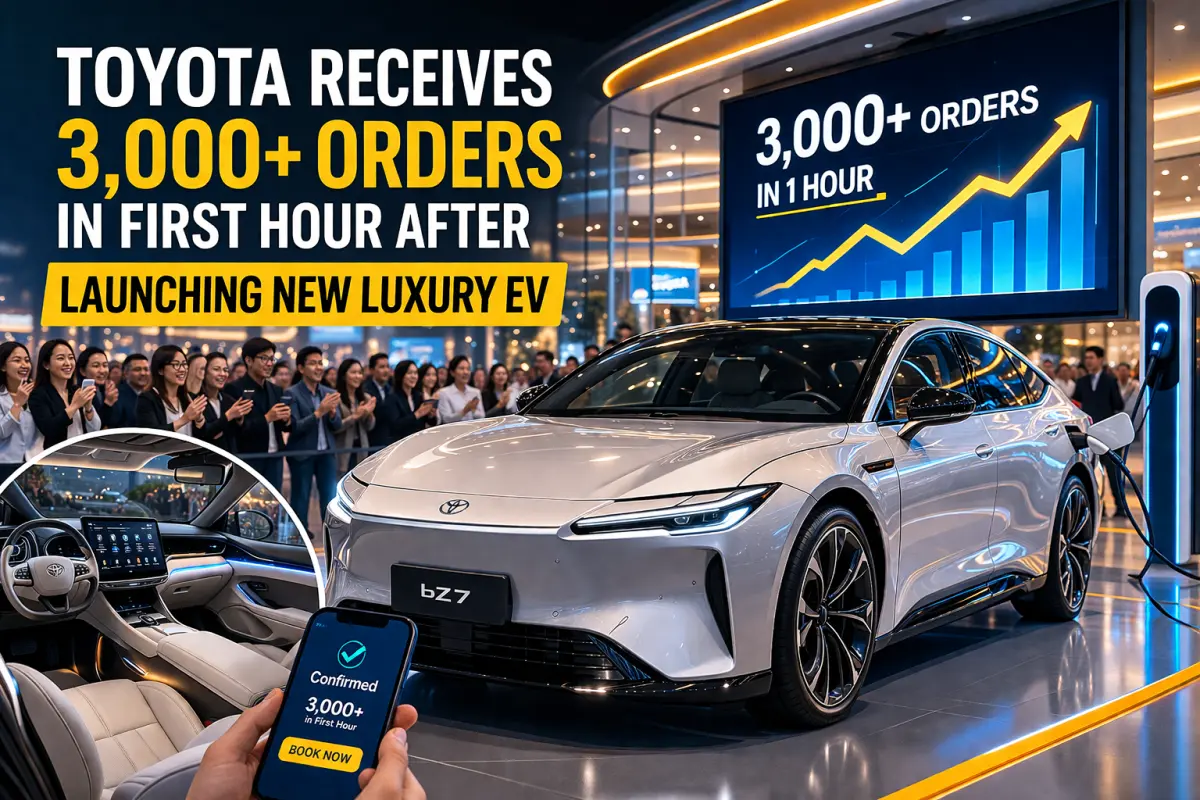
The global electric vehicle (EV) market has witnessed a defining moment as Toyota Motor Corporation recorded more than 3,000 orders within just one hour of launching its new luxury electric sedan, widely reported to be the bZ7. This remarkable response is not just a win for Toyota—it signals a broader shift in consumer sentiment toward premium electric mobility.
A Record-Breaking Launch
Toyota’s latest EV debut in China quickly turned into a headline-making event. Within the first hour of opening bookings, the company secured over 3,100 orders, surpassing expectations and demonstrating strong demand for its newest offering.
Such rapid order volumes are rare, even in the fast-growing EV market. For Toyota, a brand often perceived as cautious in its transition to fully electric vehicles, this success marks a significant turning point. The company has long been known for hybrid technology leadership, but this launch suggests it is now ready to compete aggressively in the battery-electric segment.
Meet the bZ7: Toyota’s Flagship EV
At the center of this excitement is the Toyota bZ7, a luxury electric sedan designed specifically for the Chinese market through a joint venture. Positioned as a flagship model, the vehicle blends advanced technology with premium comfort features.
The bZ7 comes in multiple variants, with prices ranging roughly between 147,800 and 199,800 yuan (approximately $21,500 to $29,000), making it surprisingly accessible for a luxury EV.
Despite its competitive pricing, the vehicle boasts specifications that rival high-end global competitors. It features battery options up to 88 kWh, delivering a driving range of up to 435 miles (around 700 km), depending on the variant.
Additionally, fast-charging capabilities allow the car to gain nearly 186 miles of range in just 10 minutes, addressing one of the biggest concerns for EV buyers—charging time.
Technology Partnerships Driving Innovation
One of the key reasons behind the overwhelming demand is Toyota’s strategic collaboration with leading Chinese technology companies. The bZ7 integrates systems developed with firms like Huawei, Xiaomi and Momenta, bringing cutting-edge software and connectivity features into the vehicle.
This partnership approach enables Toyota to offer:
Advanced driver assistance systems (ADAS) powered by LiDAR
Smart ecosystem integration linking home devices with the vehicle
AI-driven navigation and infotainment systems
Such features elevate the car beyond traditional automotive expectations, positioning it as a “smart device on wheels.”
Luxury Meets Practicality
Inside, the bZ7 emphasizes comfort and sophistication. The cabin includes features such as “zero-gravity” seats with massage functionality, a built-in refrigerator and a large digital interface that integrates driving data with entertainment controls.
The design philosophy leans toward minimalism and elegance, appealing to buyers who value understated luxury over flashy aesthetics. This aligns well with the preferences of both younger tech-savvy consumers and older buyers seeking refinement.
Interestingly, reports indicate that demand came from a wide demographic, including customers aged 40 to 60—highlighting Toyota’s strong brand trust across generations.
Why the Massive Demand?
Several factors contributed to the overwhelming response:
1. Competitive Pricing Strategy
Toyota positioned the bZ7 at a price point significantly lower than many luxury EV rivals. This makes premium electric mobility accessible to a broader audience.
2. Strong Brand Reputation
Toyota’s global reputation for reliability and quality continues to influence buyer decisions, especially in emerging EV markets.
3. Advanced Technology Integration
By incorporating cutting-edge features from top tech companies, Toyota has created a product that feels modern and future-ready.
4. Growing EV Adoption in China
China remains the world’s largest EV market, with strong government support and infrastructure development accelerating adoption.
A Strategic Move in a Competitive Market
The launch also highlights Toyota’s intent to strengthen its position in China, where local manufacturers like BYD dominate the EV segment. Entering with a competitively priced luxury model allows Toyota to target both premium buyers and those upgrading from conventional vehicles.
Industry analysts suggest that this move could intensify competition, potentially leading to price adjustments and innovation across the sector.
Moreover, the success of the bZ7 could influence Toyota’s global EV strategy. The company has already announced plans to expand its EV lineup significantly in the coming years, aiming to catch up with competitors that moved earlier into the electric space.
Implications for Global Markets
While the bZ7 is currently focused on China, its success raises questions about global availability. If introduced in markets like India, Europe, or the United States at a similar price point, demand could surge even further.
Experts believe that Toyota may eventually adapt the model or its technology for international markets, especially as EV adoption continues to grow worldwide.
In India, where EV infrastructure is still developing, a luxury EV from Toyota could play a crucial role in accelerating adoption, particularly in metro cities.
Challenges Ahead
Despite the strong start, Toyota faces several challenges:
Scaling production to meet high demand
Competing with rapidly innovating Chinese EV brands
Expanding charging infrastructure globally
Maintaining affordability while offering premium features
Meeting these challenges will determine whether the bZ7’s initial success translates into long-term dominance.
Conclusion
Toyota’s achievement of securing over 3,000 orders within an hour of launching its new luxury EV is more than just a sales milestone—it’s a clear signal of shifting consumer preferences and the accelerating transition to electric mobility.
The bZ7 combines affordability, advanced technology and premium design in a way that resonates with modern buyers. More importantly, it demonstrates that even legacy automakers can adapt and thrive in the EV era when they innovate strategically.
As the automotive industry moves toward an electric future, Toyota’s successful launch may well be remembered as a pivotal moment—one that redefined its position in the global EV race and set new benchmarks for what consumers expect from a luxury electric vehicle.

 Facebook
 Twitter
 Whatsapp
 Linkedin