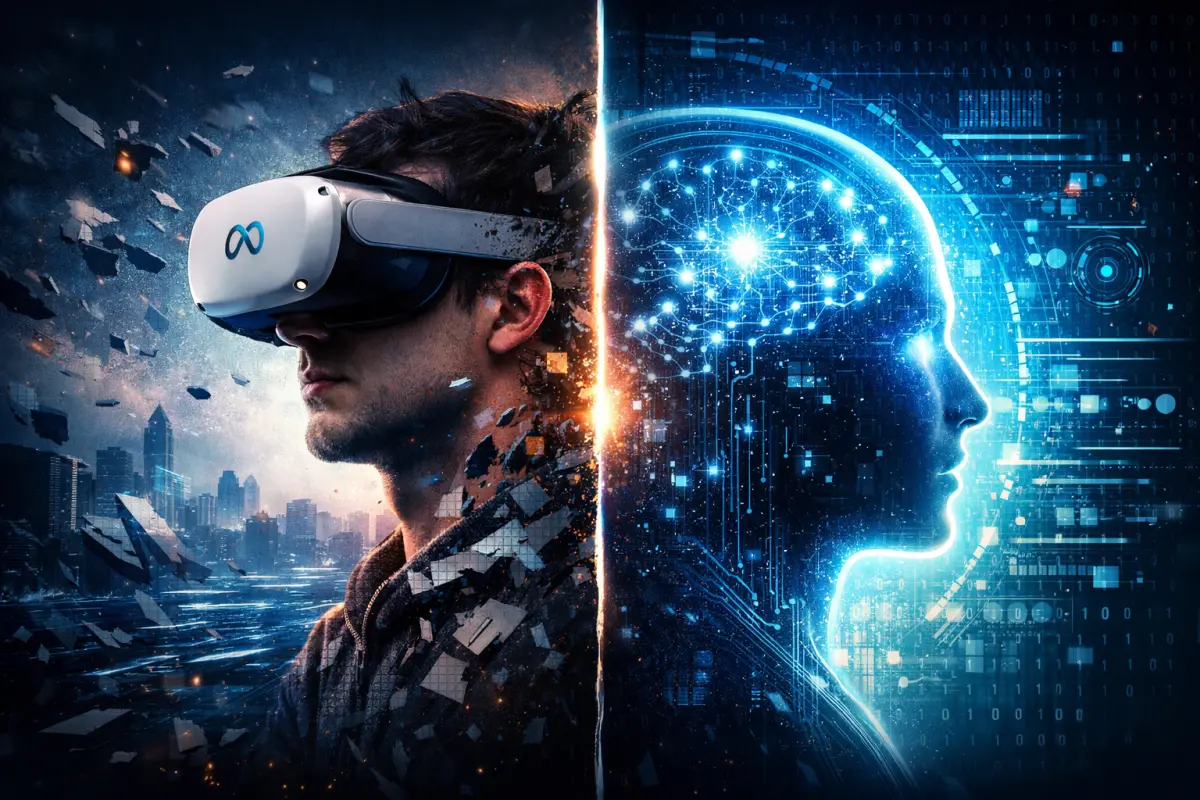
Meta’s VR Metaverse Nears Its Final End
For years, the metaverse was pitched as the future of the internet—a persistent, immersive digital world where people could work, play and socialize. When Meta (formerly Facebook) rebranded itself in 2021, it signaled a bold bet: virtual reality would define the next era of computing. Fast forward to 2026 and that vision is increasingly looking like a costly miscalculation. The latest development—Meta shutting down the VR version of its flagship platform Horizon Worlds—marks yet another step in the slow retreat of its metaverse ambitions.
Meta’s decision to discontinue Horizon Worlds on its Quest VR headsets is perhaps the clearest signal yet that its metaverse strategy is faltering. The company has confirmed that the VR experience will be removed from the Quest store by March 2026 and will cease functioning entirely by June 15, 2026.
While a mobile version of Horizon Worlds will remain, the move effectively strips the platform of its original purpose: a social universe built around immersive VR. What was once marketed as a revolutionary step forward is now being quietly scaled back into a conventional app experience.
This shift is not an isolated decision—it’s part of a broader strategic retreat. Meta has been cutting costs, laying off employees and redirecting investments toward artificial intelligence, signaling a major pivot away from the metaverse.
A Vision That Never Took Off
The idea of the metaverse was ambitious, but execution proved far more difficult. Horizon Worlds, launched in 2021, allowed users to create and explore virtual environments together. But despite the hype, it struggled to gain traction.
At its peak, the platform had only a few hundred thousand users and engagement was weak. Reports showed that most users stopped using the platform within a month and many user-created worlds were rarely visited.
This lack of sustained interest revealed a fundamental problem: people simply didn’t find enough value in spending time in virtual spaces. Unlike social media platforms such as Facebook or Instagram, the metaverse required effort—putting on a headset, navigating unfamiliar interfaces and interacting in ways that felt unnatural to many users.
The Cost Problem: Billions Burned
Meta’s metaverse ambitions came at an enormous financial cost. Its Reality Labs division, responsible for VR and AR development, has reportedly lost tens of billions of dollars over the past few years. In 2024 alone, losses reached around $17.7 billion, with cumulative losses exceeding $70 billion since 2021.
For investors, patience began to wear thin. The promise of long-term payoff was overshadowed by immediate financial strain, especially as adoption remained sluggish.
Even Meta acknowledged the problem, cutting budgets and scaling back its metaverse investments by around 30% in 2026.
The shutdown of Horizon Worlds in VR is not just a product decision—it’s a financial necessity.
Hardware Barriers Held It Back
One of the biggest obstacles to metaverse adoption has been hardware. VR headsets, while impressive, are still far from mainstream. They are expensive, bulky and often uncomfortable for long-term use.
Even the more affordable headsets require users to invest hundreds of dollars, while high-end devices can cost significantly more.
Additionally, the experience itself has limitations. Graphics are not yet at the level of realism needed for full immersion and motion sickness remains a problem for some users. These technical barriers have made it difficult for VR to achieve mass adoption.
As a result, the metaverse remained a niche experience rather than the global phenomenon Meta had envisioned.
Competition and Misaligned Strategy
Another reason for the metaverse’s decline is competition—not from other VR platforms, but from entirely different technologies.
While Meta poured billions into VR, the tech industry shifted its focus toward artificial intelligence. AI-powered tools and platforms quickly captured public imagination and delivered immediate, tangible benefits.
Meta itself has now joined this shift, investing heavily in AI infrastructure and talent.
Meanwhile, platforms like Roblox and Fortnite succeeded in creating social, immersive experiences without requiring VR headsets. These platforms proved that users were more interested in accessible, device-agnostic experiences than in fully immersive virtual worlds.
Meta’s strategy—building a VR-first metaverse—now appears misaligned with user preferences.
Internal Struggles and Layoffs
The retreat from the metaverse has also been accompanied by internal restructuring. Meta has laid off thousands of employees, particularly within its Reality Labs division.
Reports indicate that over 1,000 VR-related jobs were cut in early 2026, along with the closure of several studios and projects.
Even flagship initiatives like Horizon Workrooms, a VR collaboration tool, have been shut down.
These moves reflect a company trying to course-correct after years of aggressive investment in a vision that failed to deliver expected returns.
The Shift to Mobile and AI
Interestingly, Meta isn’t abandoning the metaverse entirely—it’s redefining it.
The company is now focusing on mobile-first experiences, aiming to make Horizon Worlds accessible without VR hardware.
This pivot suggests that Meta still believes in the concept of shared digital spaces but recognizes that VR may not be the right entry point for mass adoption.
At the same time, AI has become the new priority. From smart assistants to AI-driven content creation, Meta is positioning itself to compete in what is now the hottest sector in tech.
In many ways, AI has replaced the metaverse as the industry’s next big thing.
Is the Metaverse Really Dead?
Declaring the metaverse “dead” may be premature, but it is clearly no longer the centerpiece of Meta’s strategy.
The concept itself—shared virtual environments—still holds potential. However, its implementation is likely to evolve. Instead of fully immersive VR worlds, future metaverse-like experiences may be lighter, more accessible and integrated into existing platforms.
Meta’s continued investment in VR hardware suggests that it hasn’t completely given up. But the dream of a fully realized, VR-driven metaverse dominating everyday life has been significantly scaled back.
Lessons from Meta’s Metaverse Gamble
Meta’s journey offers several important lessons for the tech industry:
Technology alone isn’t enough: Even groundbreaking innovations need clear, compelling use cases.
User behavior matters: People prefer convenience and familiarity over complexity.
Timing is critical: The metaverse may have been ahead of its time.
Flexibility is key: Companies must adapt when their bets don’t pay off.
Conclusion: A Quiet Retreat, Not a Sudden Collapse
The shutdown of Horizon Worlds in VR doesn’t mark a dramatic end—it represents a gradual retreat from an overhyped vision. Meta’s metaverse isn’t disappearing overnight, but it is undeniably shrinking in scope and ambition.
What began as a bold reimagining of the internet has become a cautionary tale about hype, execution and the unpredictability of technological adoption.
As Meta shifts its focus to AI and mobile platforms, the metaverse is no longer the future—it’s just one of many experiments in the ever-evolving tech landscape.

 Facebook
 Twitter
 Whatsapp
 Linkedin