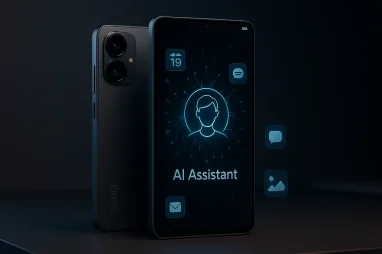
Agentic Smartphones Rise: Nubia M153 Debuts
What’s the Nubia M153?
- This
device comes from a collaboration between ZTE, which handles the hardware
design and production, and ByteDance, focusing on AI and software. So,
it’s not just AI-friendly — it’s built to be “AI-native.†36Kr+2WIRED+2
- It's
worth noting that this is still an engineering prototype and not yet a
fully commercial product, and it's available for limited online orders.
Core Hardware & Specs
Now it seems the Nubia M153 has some serious hardware to
back up those advanced AI functions:
Processor: Under the hood, it is powered by a Qualcomm
Snapdragon 8 Elite Gen 5 SoC paired with Kittyhawk technology and appears to be
one of the most powerful in terms of handling AI-related tasks.
Memory & Storage: There is 16 GB of RAM with a Storage
up to 512 GB.
Display: That’s definitely one big screen for all those AI
interactions, and it measures a whopping 6.78 inches on LTPO OLED dispensing
1264 x 2800 of resolute goodness.
Cameras: Quad camera system with 50 MP main, tele photo and wide
angle lenses; plus 50 MP front camera.
Battery & Charging: It has a massive 6000 mAh battery
and supports 15W fast charging.
What Makes Nubia M153 “Agentic�
The key feature of Nubia M153 isn’t the hardware, though —
it’s that deep integration of AI at the operating-system level done through
ByteDance’s AI agent Doubao. Here is what "agentic" means in this
context: WIRED+3Wccftech+3The Indian Express+3
Total Control of the Phone: Doubao is not your average chat
or voice assistant. It is baked into the OS of Android itself with
high-privilege “agent†capabilities. It’s capable of seeing the user interface,
navigating apps, tapping buttons and typing text, even executing sequences —
exactly as a real user would. Wccftech+2The Indian Express+2
Cross-App Multi-Step Workflows On demos, Doubao has been
able to do complicated tasks — like booking a restaurant reservation, buying
train tickets or tickets to events, doing a variety of photo editing operations
(including removing people from backgrounds), comparing prices/shopping on
different e-commerce apps and then choosing and purchasing a product — all
through voice. Wccftech+2Tech in Asia+2
Don’t rely on an app’s official API, which may not even
exist for the app you want to automate. The agent pretends to be human by
reading the screen and simulating taps/clicks (thereby bypassing direct API
access). This design provided the AI with “universal†compatibility across
nearly any app. Wccftech+2X (formerly Twitter)+2
In a way, it means at heart Doubao is not a passive
assistant (I mean reacting to voice or suggesting) but it represents the you.
The one in your head that controls the actions HM plays out for/to you, aka
truly becoming smart.
Market Reaction: Hype, Demand —
And Concerns
The first prototype had sold out on the first day of its
online availability — an indication of high curiosity and demand from early
adopters. South
China Morning Post+2Tech in Asia+2
Resale prices immediately jumped ~43% on secondary-market
platforms, further showing high interest, or at least speculation. South
China Morning Post+1
For ZTE, the good news: its stock reportedly surged ~10 %
after the announcement. Mobile
World Live+2Investing.com+2
On the negative side, analysts point out possible pitfalls:
Deep Integration at the operating system level, while
powerful, raises several concerns regarding data security and privacy. The AI,
which can access every application, view UI content, and take actions, can
touch sensitive data, payments, and cross-app data sharing-which raises several
red flags.
The "prototype" tag suggests that the device is
not quite at a mature stage yet. Camera tuning, battery optimization, and app
compatibility, among many others, still appear to be works in progress.
Adoption risk: Major smartphone manufacturers, including
those outside of China, are unlikely to replace core system functions with a
third-party AI agent, particularly dominant players who would rather build
their own AI ecosystems.
What It Means for the Future of
Smartphones & AI
- If
it ever lives up to even a fraction of its promise, the Nubia M153 could
change how we use mobile devices:
- From
“Smartphones + AI apps†to “AI-native smartphonesâ€: Instead of just having
AI-powered apps, the whole phone experience becomes intelligent — handling
complex workflows, personal assistant tasks, commerce, scheduling, and
more — all without any manual navigation.
- Reimagining
User Interaction: Thanks to agentic control, users may seldom have to open
apps manually. A single spoken request — “Book me a table at an Italian
restaurant for 7 pm†— could trigger a chain of app navigation, logins,
confirmations, and payments orchestrated by the AI.
- New
Privacy & Regulatory Challenges: The deeper device privileges AI
agents have, the more debates on data governance, consent, auditability,
user control, and transparency we can expect.
- Competition
and Ecosystem Realignment: Companies might respond by building or digging
in with their own AI agents-or by making restrictions on third-party
agents-that will create a new battleground for device-AI ecosystems.
What This Means (Globally &
for India)
- The
Nubia M153 was launched in China, but what the phone stands for is
applicable everywhere:
- In
locations like India (where you are located), these "agentic
phones" will help you simplify these processes through basic Digital
Services by having one AI Assistant that binds together everything from
travel bookings to bill payments to grocery ordering, and possibly
available in the native languages of users.
- With
the increased adoption of Mobile Internet and Apps, agentic AI could make
a smartphone less complicated for consumers, especially those with low
digital literacy.
- Conversely,
there are major concerns about data privacy, control and digital autonomy
that regulators and civil society in democracies need to take into
consideration while these devices are rolled out.
Conclusion
The Nubia M153 with Advanced ZTE Hardware and Doubao AI is
an attempt to radically change how we use our phone by allowing it to act
autonomously for us instead of being an extension of ourselves like we
currently use phones. Its success as a new Smartphone and AI Advisor, will
depend on how much the product is able to prove it can meet users’ privacy,
security concerns, and build user confidence; as well as how much ecosystem
cooperation is present. Regardless of whether the product succeeds, we look to
be moving forward not only into the era of next-generation smartphones but
potentially into the next level of human-machine?AI interaction.

 Facebook
 Twitter
 Whatsapp
 Linkedin