James Webb Space Telescope: Discoveries & Mission
Washington, D.C. — The James Webb Space Telescope
(JWST) continues to reshape modern astronomy, delivering unprecedented
insights into the early universe, distant galaxies, and exoplanet
atmospheres. As NASA and its international partners push deeper into space
exploration, JWST has emerged as one of the most important scientific
instruments of the decade.
Designed as the successor to the Hubble Space Telescope,
JWST is helping scientists answer fundamental questions about how the
universe began and whether life exists beyond Earth.
What Makes the James Webb Space
Telescope Different?
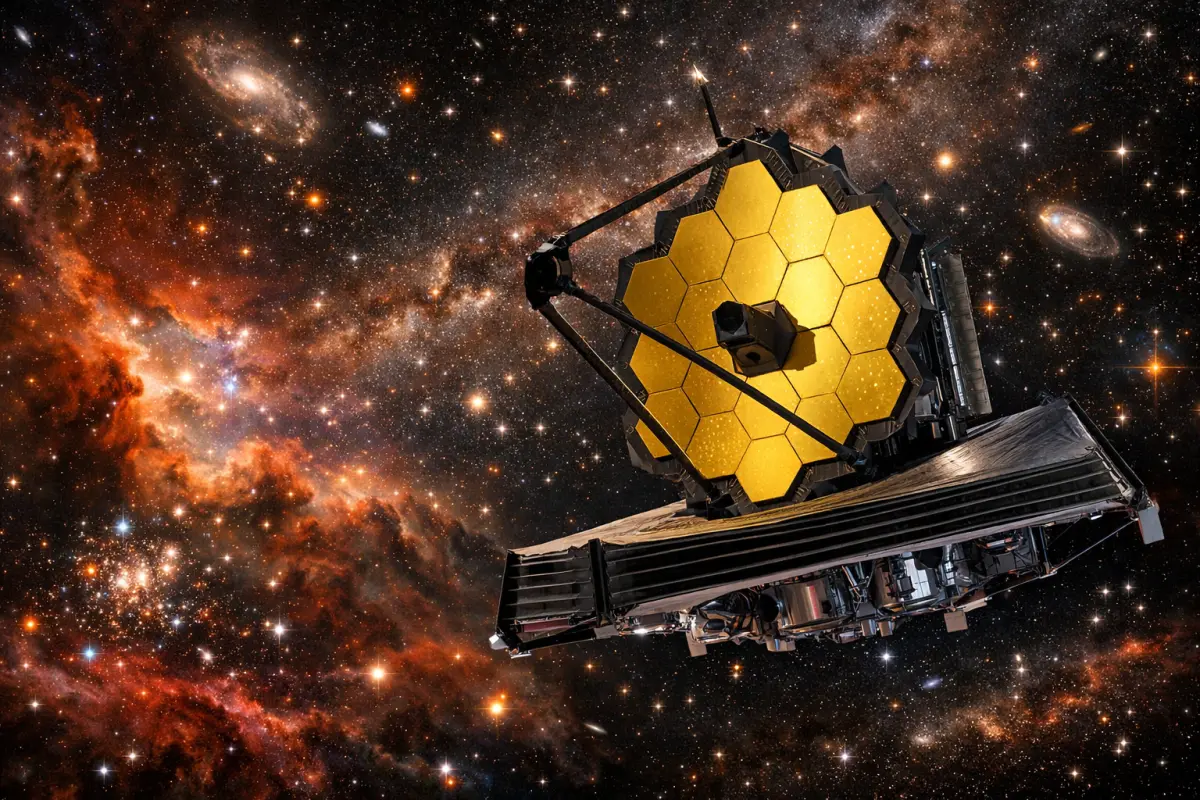
The James Webb Space Telescope is the largest and most
powerful space telescope ever launched. Unlike Hubble, which observes
mainly visible light, JWST operates primarily in the infrared spectrum,
allowing it to see through cosmic dust and observe objects formed just after
the Big Bang.
Key Features of JWST
- 6.5-meter
segmented primary mirror
- Advanced
infrared imaging and spectroscopy
- Orbiting
the Sun–Earth L2 point, 1.5 million km from Earth
- Operated
by NASA, ESA, and the Canadian Space Agency
JWST Mission Goals Explained
NASA designed JWST with four major scientific goals:
- Study
the first stars and galaxies in the early universe
- Understand
galaxy formation and evolution
- Observe
star and planet formation
- Analyze
exoplanet atmospheres for potential signs of life
These objectives place JWST at the centre of cosmology,
astrobiology, and planetary science research.
Latest James Webb Space Telescope
Discoveries
Since entering full operation, JWST has delivered some of
the most detailed cosmic images ever captured.
Recent Scientific Highlights
- Detection
of carbon dioxide, methane, and water vapor in exoplanet
atmospheres
- Deep
infrared images of ancient galaxies formed billions of years ago
- New
insights into black holes and star-forming nebulae
- High-resolution
views of regions like the Carina Nebula and Stephan’s Quintet
These findings are already reshaping scientific theories
about galaxy evolution and planetary systems.
How JWST Observations Are
Selected
JWST is operated by the Space Telescope Science Institute
(STScI) in the United States. Scientists worldwide submit research
proposals, which are reviewed based on scientific merit. Approved data
is released publicly, supporting open science and global collaboration.
Why JWST Matters for the Future
of Space Exploration
The discoveries made by the James Webb Space Telescope are
influencing future missions, including:
- The Nancy
Grace Roman Space Telescope
- Advanced
exoplanet-hunting missions
- Long-term
plans for human exploration beyond Earth
JWST is also driving innovation in space engineering,
data science, and AI-assisted astronomy.
Frequently Asked Questions
What is the James Webb Space Telescope used for?
JWST is used to study the early universe, distant galaxies,
star formation, and exoplanet atmospheres using infrared technology.
How is JWST different from Hubble?
JWST observes infrared light and has a much larger mirror,
allowing it to see farther back in time than Hubble.
Has JWST found signs of life?
JWST has detected molecules linked to life, such as water
vapor and carbon compounds, but no confirmed signs of life yet.
Why is JWST important in 2025?
JWST continues to deliver groundbreaking discoveries, making
it one of the most impactful NASA missions in modern science.
Conclusion
The James Webb Space Telescope represents a historic
leap forward in humanity’s quest to understand the universe. By revealing the
cosmos in unprecedented detail, JWST is helping scientists explore the origins
of galaxies, the nature of exoplanets, and the potential for life beyond Earth.
As new discoveries continue to emerge, JWST remains at the
forefront of space science, innovation, and exploration.

 Facebook
 Twitter
 Whatsapp
 Linkedin