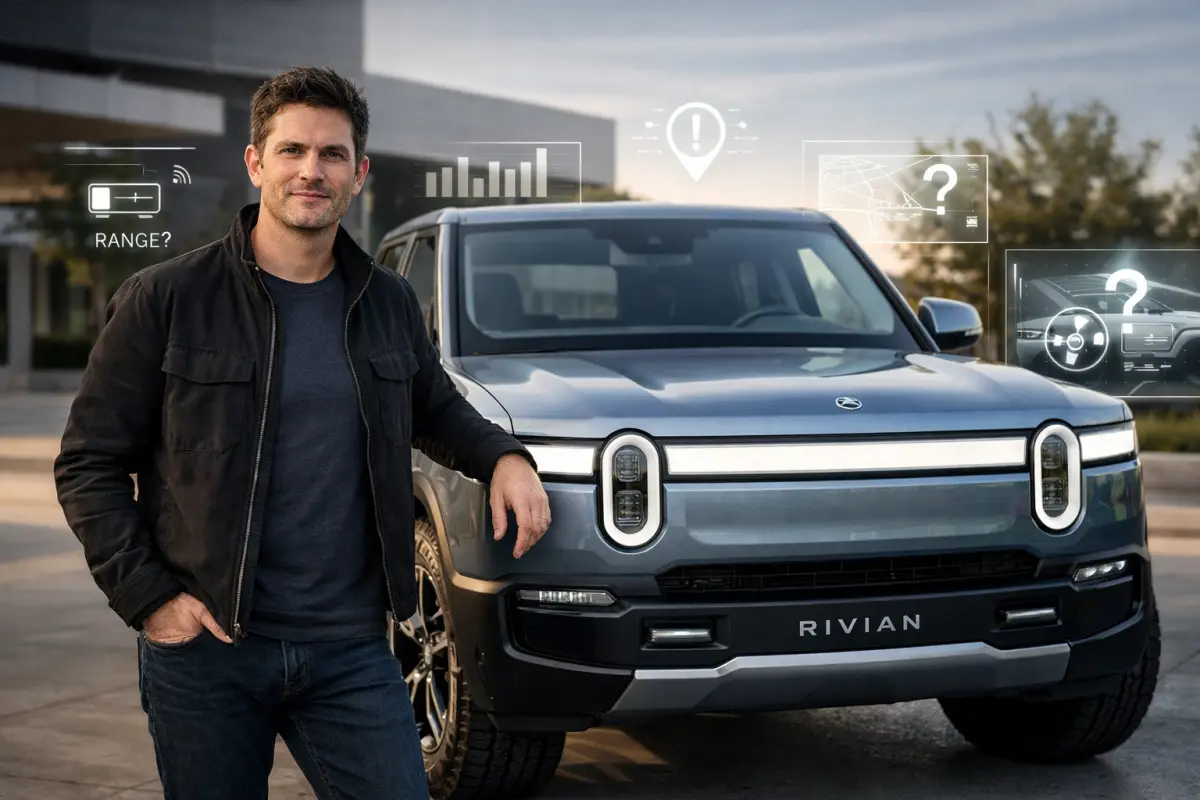
Rivian CEO RJ Scaringe Calls Out EV Gaps
At the Fortune Brainstorm AI conference in San Francisco, he
said something that really cuts through the noise: there’s a shocking lack of
choice for people who actually want to buy an affordable EV.
Sure, electric cars are everywhere in the headlines, and
yeah, the market’s growing. But Scaringe points to a deeper issue. It’s not
that folks don’t care about EVs — they do. The real problem? Most buyers don’t have enough decent, reasonably priced options. That’s what’s slowing
everything down.
Look at the numbers. EVs are only about 8% of new car sales
in the U.S., which is way behind some other places. Scaringe doesn’t blame
buyers. He blames the market. If you’re shopping for a gas-powered car, you can
pick from over 300 models in the typical price range. When you look for an
electric car at the same price point? You’re lucky if you have more than a
handful to choose from.
And if your budget is under $50,000, the field gets even
thinner. According to Scaringe, there’s really just one clear choice: Tesla.
Right now, that means the Model 3 Standard at $36,990 or the Model Y Standard
at $39,990. They’re pretty much the only affordable EVs that people actually
want — and that’s a problem if we want more drivers to go electric.
Randy​â€â€‹â€Œâ€â€‹â€â€Œâ€‹â€â€‹â€Œâ€â€‹â€â€Œ Scaringe was very direct in his
statement. He referred to the limited number of options for EVs in the U.S.
market as "not a reflection of a healthy market." Just compare them
to Europe and China—they have far more advanced.
The buyers can choose from Teslas, Volkswagens, BMWs, Mercedes, Renaults, and others. While, China is playing a completely
different game: BYD, NIO, XPeng, Leapmotor, and even Xiaomi, which has just
entered.
That kind of competition? Honestly, it just brings out how
few things are for American shoppers who want an electric vehicle that doesn’t
cost a fortune.
So here comes Rivian with its answer: the R2, a midsize
electric SUV that’s supposed to land around $45,000. It’s their most affordable
EV so far, and it’s a clear sign they’re shifting focus. Until now, Rivian has
been selling mainly upscale models like the R1T and R1S—while definitely cool
trucks and SUVs, not exactly something most families can afford.
The R2 is targeting a different audience. It is less
expensive, more compact, and designed for the general public rather than just
for the technologically advanced.
If such a tactic by Rivian is successful, it could be a real
game-changer move for the market—other automakers having to lower their prices
and provide more options. That is the kind of turn Scaringe is talking about
which is necessary for the EVs to boom big way.
Moreover, the time factor is also important. The situation
of EVs being less demanded now than before is the reason why car companies are
rethinking everything—prices, production, new models. Experts are still saying
the next big wave will be driven by practical, mid-priced EVs that families
will be able to buy. The problem is, these are hardly available at most ​â€â€‹â€Œâ€â€‹â€â€Œâ€‹â€â€‹â€Œâ€â€‹â€â€Œdealerships.
Buyers​â€â€‹â€Œâ€â€‹â€â€Œâ€‹â€â€‹â€Œâ€â€‹â€â€Œ are always
on the lookout for:
- Long-range
EVs under $50K
- Reliable
EVs for commuting
- Family
EVs with good charging support
– At present, those inquiries only result in a few feasible
options, and the availability of these options is limited to a few locations
only.
RJ Scaringe Supports Rebuilding
Domestic Manufacturing
RJ Scaringe also indicated that he supports the
reconstruction of domestic manufacturing, which is in line with the current
government's move to concentrate more production in the country, during his
interview. The local EV production is an important factor in terms of:
- Reducing supply chain risk
- Supporting sustainable innovation
- Creating manufacturing jobs
– For Rivian, which has a domestic vehicle production model,
intensifying U.S. production is a significant element of its long-term
strategy.
Looking Beyond the U.S. Shows the
Competition Is Getting Intense
- While
the American market is grappling with a restricted number of choices,
other markets are booming at a fast pace.
- Europe
- EV
sales are primarily led by:
- Tesla
- Mercedes-Benz
- BMW
- Volkswagen
- Hyundai
and Kia
Moreover, Europeans have more small and less expensive EV
models because of rigorous emission regulations and high fuel costs.
China
China is still the most challenging market for EVs
worldwide.
BYD, NIO, XPeng, Leapmotor, and Xiaomi, to name a
few, are the companies that compete fiercely with each other; therefore, the
consequences of the competition are:
- advancement
of battery technology
This worldwide competition emphasizes the necessity for
variety; otherwise, the American market will not be able to keep up with the
pace.
The crux of the matter: there is
EV demand — but no choice
R.J. Scaringe communicated his point in a very simple way:
People want electric vehicles but the problem is that there are not enough
affordable options available to them.
The market will continue to be depressed compared to global
EV leaders if car manufacturers decide to launch electric models which are
either high-end or luxury, and not accessible or practical, until there are
more accessible and practical electric models from automakers.
Rivian, with the focus back on affordable EV development and
the upcoming R2, hopes to be part of the industry turning.
The next two years will be very important in showing how
fast the market will change and which companies will lead the ​â€â€‹â€Œâ€â€‹â€â€Œâ€‹â€â€‹â€Œâ€â€‹â€â€Œchange.

 Facebook
 Twitter
 Whatsapp
 Linkedin