Smart Sensors in Cars: Tech Powering Driving
Modern vehicles are no longer defined only by engines,
batteries, or design. Instead, they are increasingly shaped by something far
less visible but far more powerful: smart sensors.
From advanced driver-assistance systems to autonomous
driving features, smart sensors in modern vehicles are becoming the
foundation of safety, efficiency and intelligence on the road. As cars evolve
into software-defined machines, sensors act as the eyes, ears and nervous
system that make this transformation possible.
What Are Smart Sensors in
Vehicles?
Smart sensors are advanced electronic components that detect,
process and transmit data in real time. Unlike traditional sensors, they
combine sensing elements with onboard processing, allowing vehicles to
interpret conditions instantly and respond accordingly.
In modern vehicles, smart sensors monitor everything from
road conditions and vehicle speed to driver behavior and surrounding
traffic—often without the driver even noticing.
Why Smart Sensors Are Critical to
Modern Cars
The shift toward electric, connected and autonomous vehicles
has made sensors indispensable.
Smart sensors enable:
- Real-time
awareness of the vehicle’s surroundings
- Improved
safety through rapid hazard detection
- Greater
efficiency in energy and fuel usage
- Seamless
communication between vehicle systems
As a result, sensors are no longer optional add-ons—they are
core to how vehicles function.
Key Types of Smart Sensors Used
in Modern Vehicles
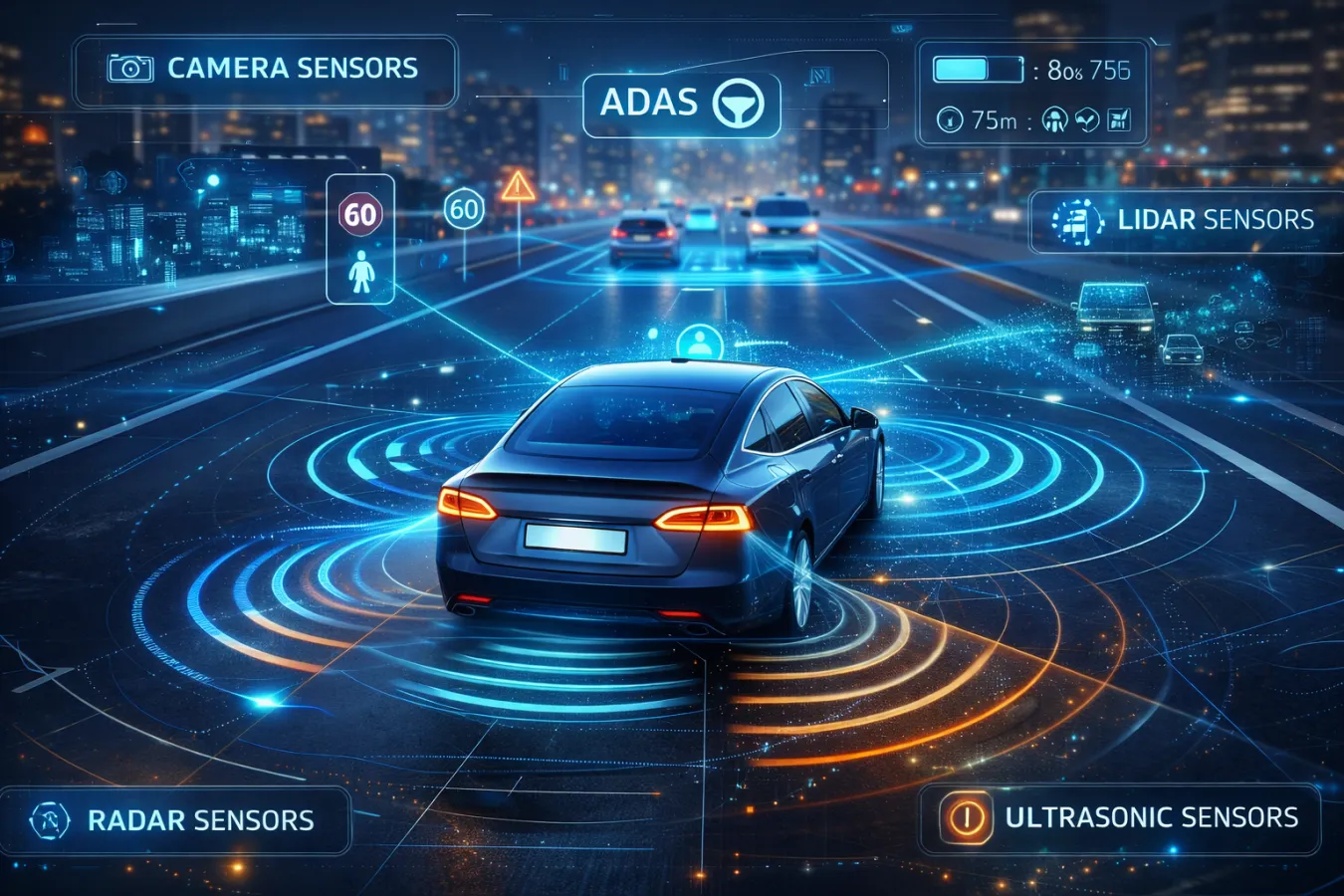
Camera Sensors: Visual Intelligence on the Road
Camera sensors provide high-resolution visual data used in:
- Lane-keeping
assistance
- Traffic
sign recognition
- Pedestrian
and cyclist detection
- Driver
monitoring systems
With the help of AI, these cameras can interpret complex
environments, making them essential for semi-autonomous and autonomous driving
features.
Radar Sensors: Seeing Through Weather and Darkness
Radar sensors use radio waves to detect objects at long
distances.
They are widely used for:
- Adaptive
cruise control
- Collision
avoidance systems
- Blind-spot
detection
Radar remains reliable in fog, rain and low-light
conditions, making it a critical safety component in modern vehicles.
LiDAR Sensors: Mapping the World in 3D
LiDAR (Light Detection and Ranging) sensors create detailed
3D maps of the vehicle’s surroundings.
While still more common in high-end or autonomous vehicles,
LiDAR enables:
- Precise
distance measurement
- High-accuracy
object recognition
- Advanced
autonomous navigation
As costs decline, LiDAR adoption is expected to grow across
more vehicle segments.
Ultrasonic Sensors: Close-Range Awareness
Ultrasonic sensors operate at short distances and are
typically used for:
- Parking
assistance
- Low-speed
obstacle detection
- Automated
parking systems
Though simple compared to other sensors, they play a vital
role in everyday driving convenience.
In-Vehicle Sensors: Monitoring the Car and the Driver
Modern vehicles also rely on internal sensors that track:
- Tire
pressure and temperature
- Battery
health and energy usage
- Driver
attention and fatigue
- Cabin
air quality
These sensors support both safety and comfort, while also
enabling predictive maintenance.
Smart Sensors and Vehicle Safety
One of the biggest impacts of smart sensors is improved road
safety.
By continuously analyzing data, sensor-driven systems can:
- Detect
potential collisions before they occur
- Automatically
apply brakes or adjust steering
- Alert
drivers to hazards they may not notice
These capabilities are already reducing accidents and will
become even more important as traffic systems grow more complex.
The Role of Sensors in Autonomous
and Electric Vehicles
Smart sensors are the backbone of autonomous driving.
Self-driving systems rely on sensor fusion, where data from cameras,
radar, LiDAR and ultrasonic sensors is combined to create a complete
understanding of the environment.
In electric vehicles, sensors also help:
- Optimize
battery performance
- Manage
thermal systems
- Improve
driving range through efficiency monitoring
Without smart sensors, autonomy and electrification at scale
would not be possible.
Challenges Facing Automotive
Sensor Technology
Despite rapid progress, smart sensor technology still faces
challenges:
- High
costs for advanced sensors like LiDAR
- Massive
data processing requirements
- Cybersecurity
and data privacy risks
- Reliability
in extreme environments
Automakers and suppliers continue to invest heavily in
solving these issues.
Why Smart Sensors Matter for the
Future of Mobility
As vehicles become more connected and autonomous, the
importance of smart sensors will only increase.
They are enabling:
- Safer
roads
- Smarter
traffic systems
- More
efficient energy use
- A
smoother transition to autonomous mobility
In many ways, sensors are becoming as important as engines
once were.
Conclusion
Smart sensors may not be visible to drivers, but they are
transforming how vehicles operate. From preventing accidents to enabling
self-driving capabilities, these technologies are quietly reshaping the
automotive industry.
The future of driving will not be defined by how fast a car
can go—but by how intelligently it can sense, understand and respond to the
world around it.

 Facebook
 Twitter
 Whatsapp
 Linkedin