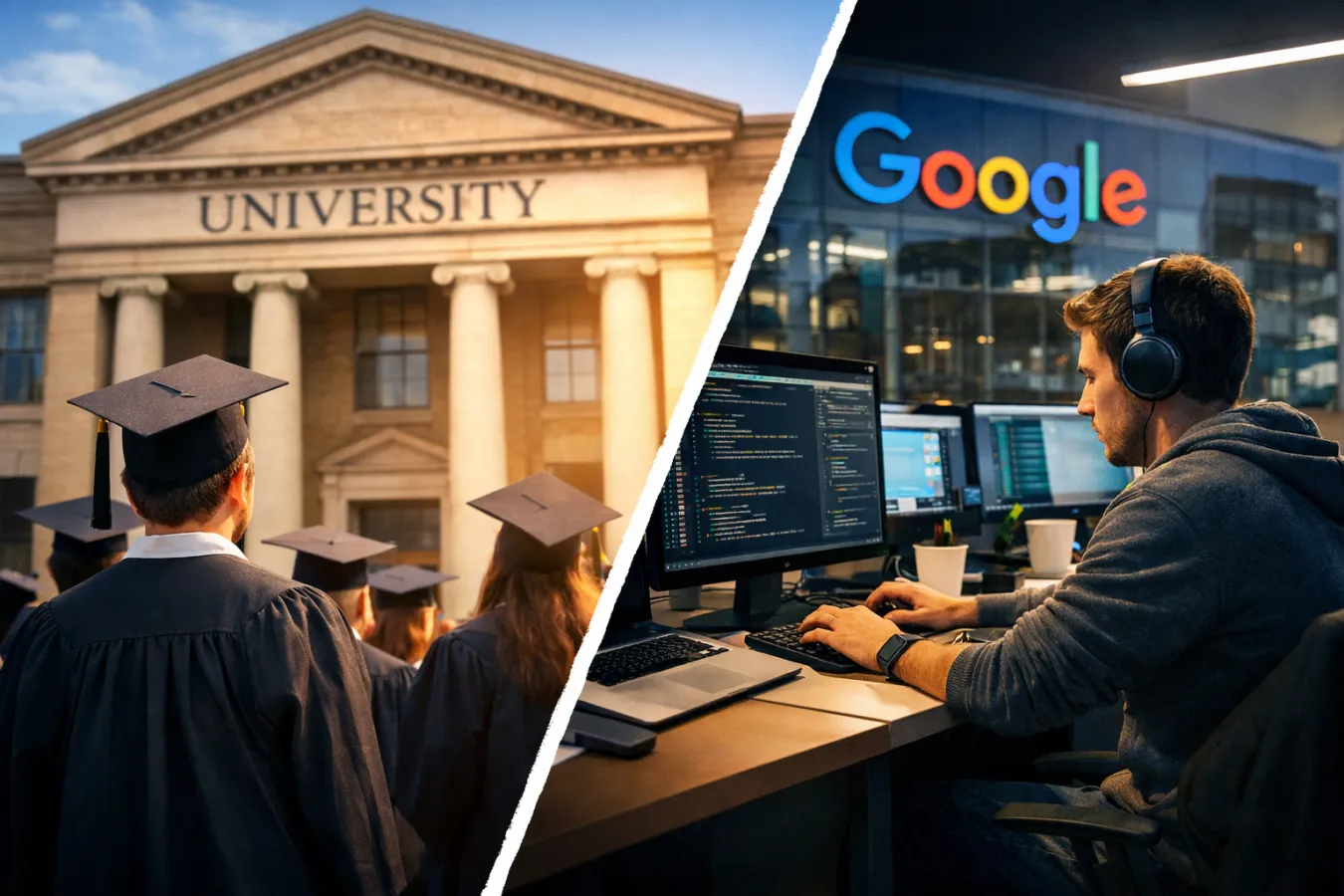
Google Hires Without Degrees: CEO Shift
The traditional career formula—earn a degree, get hired,
climb the ladder—has been a reliable script for decades. But in 2026, that
script is being rewritten in real time.
In a recent discussion with students, Google cofounder
Sergey Brin said the company has hired “tons†of people who don’t have
bachelor’s degrees. According to Brin, many of these hires are self-taught,
highly adaptable and able to learn quickly outside the classroom—skills that
can matter more than a formal credential in modern tech roles.
His comments have reignited an already growing debate across
business leadership: is a university degree still the best indicator of talent,
or has it become an expensive requirement that no longer matches how people
actually learn and work?
From Silicon Valley to Wall Street, more CEOs are
questioning whether college is the only path to success—and whether the current
university system is delivering the return on investment it promises.
Brin’s message: learning matters
more than the label
Brin’s statement wasn’t framed as an attack on higher
education. In fact, he has often spoken about curiosity and learning as central
to innovation. But his point was clear: Google is finding capable people who
didn’t follow the traditional “degree-first†route.
That’s significant because Google has long been associated
with elite hiring—high academic performance, top universities and strong
technical backgrounds. Hearing a cofounder openly highlight non-degree hires
sends a signal that the company’s definition of “qualified†is broader than it
used to be.
In Brin’s view, some people simply “figure things out†on
their own. They learn by building, experimenting, failing and improving—without
needing a formal campus environment to validate their ability.
And in the tech world, that kind of independent
problem-solving can be just as valuable as classroom knowledge.
Why the degree debate is getting
louder now
The idea that degrees aren’t always necessary isn’t new. But
it’s becoming louder and more mainstream for a few reasons.
1) Tuition costs keep rising
For many families, college has become one of the biggest
financial commitments they’ll ever make. When students graduate with
significant debt, the pressure increases to prove that the degree leads to a
strong job—and quickly.
But the job market doesn’t always cooperate. In many
countries, including the U.S., students have reported frustration that
entry-level jobs demand experience they don’t yet have, even after completing a
degree.
That gap between “education promise†and “job reality†is
pushing more people to ask: is there a smarter route?
2) The internet changed how people learn
A university used to be the main place where advanced
learning happened. Today, almost anyone can access high-quality education from
anywhere—coding tutorials, free courses, AI tools, online communities and
open-source projects.
This doesn’t mean online learning automatically equals a
degree. But it does mean the monopoly on knowledge is gone.
When a motivated learner can gain job-ready skills without
spending four years in a classroom, employers naturally start paying attention.
3) Employers care about proof of ability
A degree is a credential. It suggests someone has completed
a structured program, met certain standards and spent time learning.
But companies increasingly want something even more direct:
proof.
In many roles, employers want to see:
- real
projects
- a
portfolio
- practical
skills
- problem-solving
under pressure
- communication
and teamwork
- the
ability to learn fast
A transcript doesn’t always show those things. But real work
often does.
4) AI is reshaping what “entry-level†looks like
Artificial intelligence tools are changing the way work gets
done, especially in fields like software development, design, marketing and
data analysis.
Tasks that once required junior employees can now be
assisted—or partially automated—by AI. That means companies may hire fewer
entry-level workers, or they may expect new hires to contribute at a higher
level from day one.
In this environment, the ability to adapt, learn quickly and
solve unfamiliar problems can matter more than a traditional credential.
CEOs questioning universities:
what’s the real value?
Brin isn’t the only high-profile leader raising eyebrows
about the degree system. In recent years, many executives have openly
questioned whether universities are preparing students for the realities of
work—or simply selling a costly credential.
This CEO skepticism usually centers around three major
themes:
Degrees don’t guarantee job readiness
Employers often say graduates know theory but lack practical
skills. Many students spend years studying concepts but don’t get enough
experience building real-world solutions.
For tech roles, this is especially obvious. A student might
graduate with strong grades but still struggle with:
- debugging
real systems
- collaborating
in teams
- working
with production tools
- understanding
product requirements
- writing
clean, maintainable code
Companies want people who can perform in real environments,
not just pass exams.
Universities can be slow to adapt
The job market evolves quickly. Universities often move
slower due to academic structure, policy and long curriculum cycles.
Meanwhile, industries like AI, cybersecurity and cloud
computing can change drastically in just a couple of years. That creates a
mismatch where students graduate with skills that are already outdated.
Credential inflation is real
Many jobs that didn’t require degrees 20 years ago now list
degrees as a “must-have.†This isn’t always because the job became more
complex—it’s often because degrees became a convenient filter.
For employers, a degree requirement can reduce applications.
For candidates, it can become a barrier even when they can do the job.
This is sometimes called the “paper ceilingâ€â€”where talented
people without degrees are blocked from opportunities even if they have the
skills.
What Google’s hiring trend
suggests
When a company like Google openly talks about hiring people
without degrees, it doesn’t mean degrees are irrelevant. It means the hiring
strategy is evolving.
Google still hires many graduates. But the bigger shift is
this: a degree is becoming one option among many, not the only acceptable path.
That shift is especially important for roles where
performance can be measured directly.
For example, in software engineering, it’s often possible to
evaluate candidates based on:
- coding
tests
- system
design interviews
- project
history
- contributions
to real products
- problem-solving
approach
A degree may help, but it isn’t always necessary if someone
can demonstrate strong ability.
The rise of “skills-first†hiring
The phrase “skills-first hiring†is becoming popular in HR
and leadership circles. It means hiring based on what someone can do, not just
what credentials they hold.
Skills-first hiring is growing because it can solve multiple
business problems at once:
- it
expands the talent pool
- it
reduces hiring bottlenecks
- it
helps companies find non-traditional talent
- it
may improve diversity and inclusion outcomes
- it
focuses on performance rather than prestige
But it also creates a new challenge: evaluating skills
fairly and consistently.
Not every company has strong systems to test real ability.
Some still rely on degrees because it’s easy and familiar.
So while skills-first hiring is rising, it’s not evenly
applied everywhere.
Should students stop going to
college?
Not necessarily—and anyone claiming “college is useless†is
oversimplifying.
A degree can still be extremely valuable, especially in
fields where formal education is essential, such as:
- medicine
- law
- civil
engineering
- scientific
research
- certain
regulated professions
Even in tech, a strong computer science foundation can help
long-term growth, especially for complex areas like:
- machine
learning research
- advanced
systems engineering
- robotics
- distributed
computing
- cryptography
College can also offer benefits that are hard to replicate
online:
- structured
learning
- mentorship
- peer
networks
- internships
and campus recruiting
- exposure
to research and labs
- personal
development and independence
The real shift is that college is no longer the only
credible route—and for some careers, it may not be the best value.
What matters most now: proof,
portfolio and progress
If more top companies are open to hiring non-degree
candidates, the winning strategy becomes clearer:
Build proof of work
Instead of relying only on certificates or claims,
candidates can show results through:
- a
personal portfolio website
- GitHub
projects
- real
apps or tools
- freelance
work
- internships
- open-source
contributions
- case
studies and documentation
This “show your work†approach can be powerful, especially
in tech and creative fields.
Learn continuously
One of the strongest signals employers look for today is
learning speed.
In fast-changing industries, the most valuable employees
aren’t just the ones who know the most today—they’re the ones who can learn
what’s needed tomorrow.
Improve communication skills
Many candidates underestimate this, but communication often
separates average hires from top hires.
Even in technical roles, companies want people who can:
- explain
ideas clearly
- collaborate
with teams
- write
good documentation
- understand
business needs
- work
with deadlines and feedback
A strong communicator with solid skills can beat a highly
educated candidate who can’t work well with others.
What universities may need to
change
As more CEOs question the degree system, universities may
face increasing pressure to evolve.
Some likely changes include:
- more
hands-on, project-based learning
- stronger
industry partnerships
- internships
integrated into degrees
- flexible
programs and shorter pathways
- modern
curriculum updates (AI, cloud, cybersecurity)
- career
outcomes measured more transparently
Universities that adapt could become even more valuable.
Those that don’t may struggle as alternative learning routes gain credibility.
The bigger message behind Brin’s
comment
Sergey Brin’s statement about Google hiring “tons†of people
without degrees isn’t just a headline. It reflects a deeper transformation in
how companies define talent.
In the past, a degree was often treated as a requirement.
Now it’s increasingly treated as a signal—one of many signals.
In a world where skills can be learned outside classrooms,
where portfolios can be built online and where AI is reshaping job roles,
employers are adjusting their filters.
The takeaway for job seekers is not “skip college at all
costs.†It’s this:
Your ability to learn, build and prove your skills
matters more than ever.
And for universities, the warning is equally clear:
If education is the product, students and employers are
starting to demand better value.

 Facebook
 Twitter
 Whatsapp
 Linkedin