Antarctica Sea Ice Mystery Solved by Robots
A sudden and puzzling shift
For decades, the icy waters surrounding Antarctica behaved in a way that puzzled scientists. From the late 20th century through the early 2010s, Antarctic sea ice was actually expanding—despite global warming trends elsewhere. Then, almost abruptly around 2016, that pattern reversed. Sea ice began to shrink dramatically and has remained at unusually low levels ever since.
This sudden shift raised a critical question: What changed? Understanding Antarctic sea ice is not just about the polar regions—it plays a crucial role in regulating Earth’s climate, ocean circulation and even global sea levels. If the Antarctic ice system destabilizes, it could accelerate melting of the continent’s massive ice sheets, which hold enough water to raise sea levels by nearly 60 meters if fully lost.
Now, thanks to a fleet of deep-diving robotic instruments, scientists are finally beginning to unravel this mystery.
The rise of ocean robots in polar science
Studying Antarctica is one of the most difficult challenges in Earth science. Thick ice cover, extreme cold and remote geography limit direct human observation. Satellites offer valuable data, but they can’t fully capture what’s happening beneath the ocean surface.
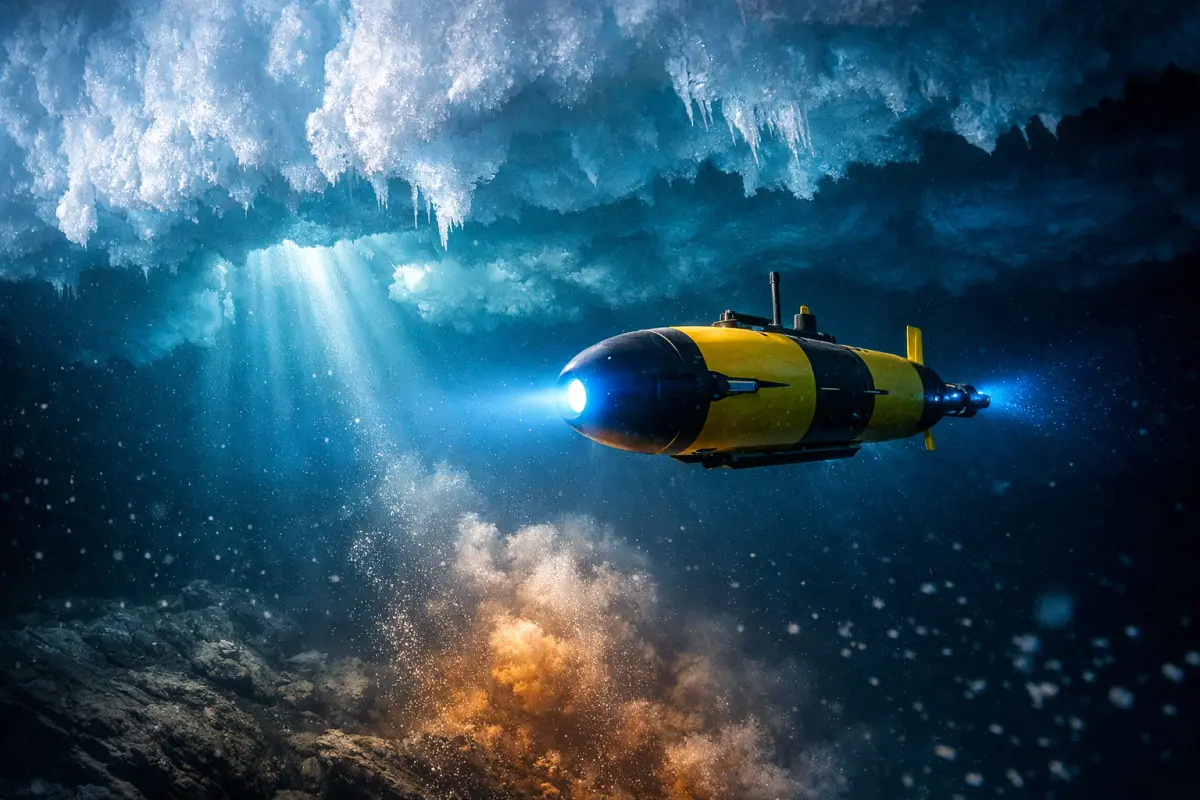
This is where robotic explorers—particularly autonomous underwater instruments—have revolutionized research. Among the most important tools are Argo floats, torpedo-shaped robots that drift through the ocean. These devices can dive thousands of feet below the surface, recording temperature, salinity and other key variables before resurfacing to transmit data via satellite.
Unlike traditional expeditions, which are expensive and short-lived, these robots continuously collect data for years. Some have even survived months beneath Antarctic ice shelves, reaching areas never previously studied.
Their persistence and reach have opened a new window into the hidden dynamics of the Southern Ocean.
A “violent release” of hidden heat
Data gathered by these robotic systems has led scientists to a striking conclusion: the disappearance of Antarctic sea ice may be driven by a sudden release of stored heat from deep ocean layers.
For years, the ocean beneath Antarctica had been quietly accumulating heat. This heat was effectively trapped below the surface due to layers of colder, fresher water above it. But changing wind patterns and ocean circulation eventually disrupted this balance.
When that happened, warmer water from the depths rose toward the surface—a process sometimes described as a “very violent release” of pent-up heat.
This upward surge of heat melted sea ice from below, accelerating its decline in a way that surface air temperatures alone could not explain.
The role of salinity, winds and ocean mixing
The robotic observations revealed that Antarctic sea ice isn’t controlled by a single factor. Instead, it is shaped by a complex interplay of ocean and atmospheric processes:
1. Salinity layers
The Southern Ocean is stratified, meaning different layers have different densities. Freshwater from melting ice sits on top, while saltier, warmer water lies below. When this layering is disturbed, heat can move upward more easily.
2. Wind patterns
Changes in wind strength and direction can stir the ocean, breaking down these layers. Strong winds can push surface waters aside, allowing deeper warm water to rise.
3. Ocean “churn”
This mixing process—often called ocean overturning—plays a key role in redistributing heat. The robots showed that even subtle shifts in circulation can have large impacts on sea ice formation and loss.
Together, these factors explain why Antarctic sea ice remained stable for decades and then suddenly declined. It wasn’t just gradual warming—it was a tipping point triggered by changes in the ocean system.
Why this discovery matters
Understanding the drivers of Antarctic sea ice loss is critical for several reasons:
Climate feedback loops
Sea ice reflects sunlight back into space. When it melts, darker ocean water absorbs more heat, accelerating warming in a feedback loop.
Ice sheet stability
Sea ice acts as a buffer, protecting the massive ice shelves attached to the continent. Without it, glaciers can flow more rapidly into the ocean, contributing to sea-level rise.
Global ocean circulation
Antarctica plays a central role in driving global ocean currents. Changes in sea ice and water temperature can disrupt these systems, affecting weather patterns worldwide.
Improved climate models
Before the deployment of deep-diving robots, many climate models lacked detailed data from beneath the Antarctic surface. Now, scientists can refine predictions about future ice loss and sea-level rise with greater accuracy.
Robots: the future of polar exploration
The success of Argo floats and other underwater robots marks a turning point in how scientists study extreme environments. These machines are not just tools—they are becoming essential partners in climate research.
New generations of robotic probes are being developed to go even further. Some are designed to navigate under thick ice shelves, mapping their undersides and measuring melt rates with unprecedented precision.
Others can remain submerged for months or even years, collecting continuous data in regions that are completely inaccessible to humans.
In one remarkable case, a robotic float drifted into an unexplored Antarctic cavity and returned with valuable data that scientists had never expected to obtain.
These breakthroughs highlight how autonomous systems are expanding the boundaries of scientific discovery.
A changing Antarctica
The story of Antarctica’s vanishing sea ice is a reminder that Earth’s climate system is not always gradual or predictable. Sometimes, it changes suddenly—driven by hidden forces deep beneath the surface.
The discovery of heat release from the ocean underscores how interconnected our planet is. What happens in the depths of the Southern Ocean can ripple outward, influencing global climate, ecosystems and sea levels.
At the same time, the research offers a note of cautious optimism. With better tools and deeper insights, scientists are now more equipped than ever to understand and respond to these changes.
Conclusion
Deep-diving robots have transformed a long-standing scientific mystery into a clearer picture of how Antarctica works. By revealing the role of ocean heat, salinity and circulation, they have shown that the disappearance of sea ice is not just a surface phenomenon—but a deep, dynamic process driven by the ocean itself.
As climate change continues to reshape the planet, these robotic explorers will remain at the forefront of discovery—quietly diving beneath the ice, gathering the data that helps humanity understand its future.
In the frozen silence of Antarctica, it turns out the most important clues were hidden far below—and it took machines, not humans, to find them.

 Facebook
 Twitter
 Whatsapp
 Linkedin