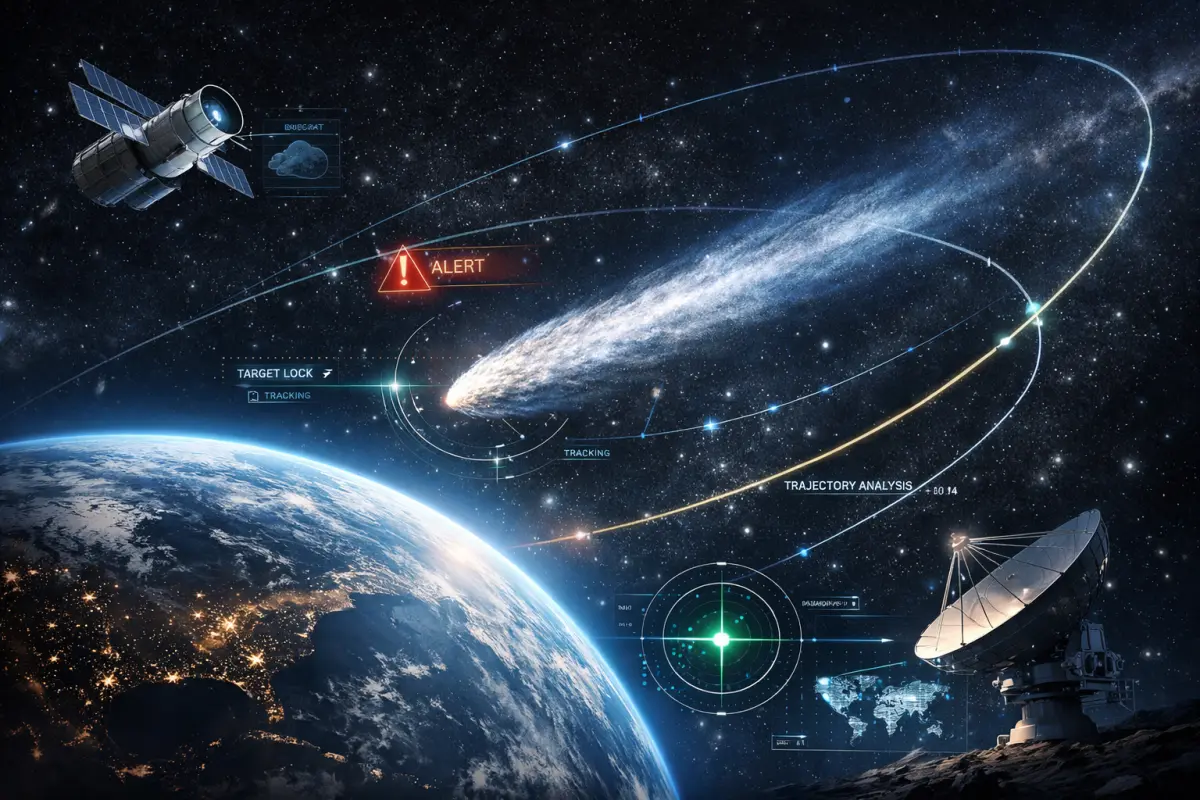
Planetary Defense Drill Tests Interstellar Comet
Space agencies around the world are collaborating in the largest
coordinated planetary defence exercise in history, using the rare
interstellar visitor 3I/ATLAS to test and refine Earth’s readiness
against potential cosmic threats.
This unprecedented drill — involving scientific
institutions, telescopes, and monitoring networks from multiple nations — is
drawing global attention and sending a clear message: planetary defence is
no longer theoretical.
What Is 3I/ATLAS?
The interstellar comet 3I/ATLAS (C/2025 N1) was
discovered on July 1, 2025, by the ATLAS survey telescope in Chile. It
is only the third confirmed object from outside the Solar System ever
observed, following ’Oumuamua and 2I/Borisov. Wikipedia
Unlike typical comets or asteroids that orbit the Sun,
3I/ATLAS follows a hyperbolic trajectory, meaning it’s passing through
our solar neighbourhood from deep space and will continue outward after its
close approach — yet it poses no impact threat to Earth.
The Largest Planetary Defence
Drill Ever
From late November 2025 through January 2026, space
agencies and planetary defence networks are conducting a global simulation to test
early detection, tracking, data sharing, and coordinated response strategies
against potentially hazardous cosmic objects.
New York Post+1
The exercise is coordinated by the International Asteroid
Warning Network (IAWN) — a United Nations‑endorsed collaboration that
includes NASA, the European Space Agency (ESA), and observatories across
more than 23 countries.
🚀 Key Goals of the Drill
- Improve
detection and tracking of near‑Earth objects (NEOs) using ground‑based
and space‑based observatories
- Test
international data sharing and coordinated response systems.
- Refine
observation techniques for objects with unusual trajectories like
interstellar visitors.
Live Science
- Advance
early warning systems, preparing for future potentially hazardous
asteroids or comets.
Science & Nature Blog
Even though 3I/ATLAS will stay safely over 170 million
miles from Earth, its passage provides a real‑world scenario for
testing how global networks could respond if a similar object had a more
dangerous path.
NewsBytes
How the Drill Works
Advanced Observation Campaigns
Participating observatories and spacecraft — including the
NASA Mars Reconnaissance Orbiter and major ground telescopes — are tracking
3I/ATLAS to:
- Measure
its brightness, trajectory, and composition
- Improve
orbit prediction and tracking accuracy
- Share
real‑time data internationally
This global collaboration not only aids scientific research
but also significantly boosts Earth’s planetary defence capabilities.
NewsBytes
Interstellar Object Monitoring
The IAWN campaign is also collecting observations from
hundreds of observatories and citizen scientists worldwide. These measurements
refine our understanding of how fast‑moving objects behave and improve
detection techniques for future threats.
Live Science
Why This Matters for Earth’s
Safety
Although 3I/ATLAS is not hazardous, the drill underscores
how seriously the scientific community now treats planetary defence and near
Earth object tracking — previously niche research areas that are now
mainstream global priorities.
🔑 Long‑Term Benefits
- Strengthened
early warning systems
- Improved
international coordination
- Better
preparedness for real impact scenarios
- Enhanced
public awareness of planetary risks
This exercise also builds upon previous planetary defense
initiatives such as NASA’s Double Asteroid Redirection Test (DART),
which successfully demonstrated asteroid deflection techniques in 2022.
The Future of Planetary Defence
The 3I/ATLAS campaign represents a major milestone in
how human civilisation prepares for cosmic hazards. From improved sky surveys
to real‑time data sharing across continents, the world is collectively moving
toward a future where planetary defence is robust, proactive, and globally
coordinated.
With new technologies, enhanced tracking systems, and
international collaboration, Earth’s defences against cosmic threats are
stronger than ever.

 Facebook
 Twitter
 Whatsapp
 Linkedin