Space-Based AI: GPU Satellites & Future Cloud
Artificial intelligence is pushing the limits of Earth-based
infrastructure. Data centers are running hotter, energy demands are rising and
latency is becoming a bottleneck for real-time global applications. Now, a bold
idea is gaining traction among aerospace companies, AI researchers and U.S.
defense agencies: space-based AI infrastructure powered by GPU-equipped
satellites.
These orbiting systems could transform how AI models are
trained, deployed and scaled—marking a shift toward AI computing beyond
Earth. What once sounded like science fiction is quickly becoming a serious
technological and strategic conversation.
This article explores what space-based AI computing is,
why it matters, who’s building it and how it could reshape
cloud computing, national security and global connectivity.
What Is Space-Based AI
Infrastructure?
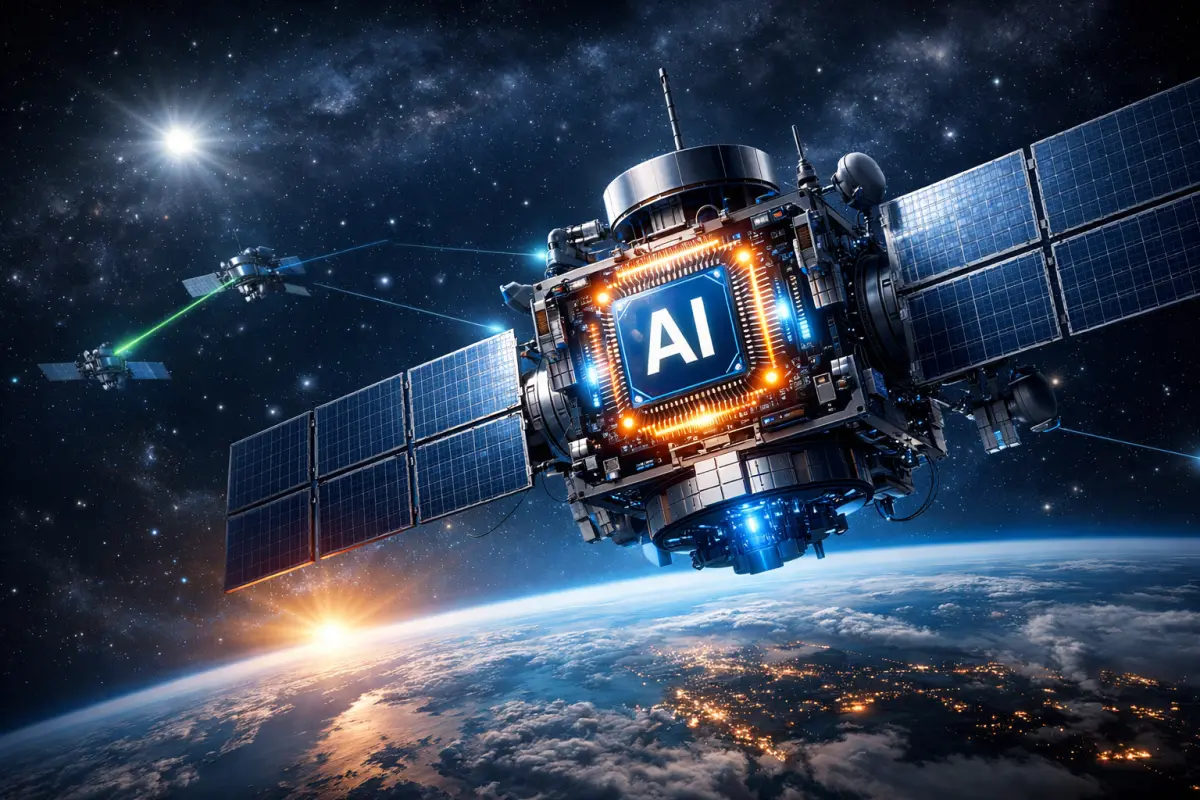
Space-based AI infrastructure refers to satellites
equipped with high-performance computing hardware—especially AI GPUs and
edge processors—that can process data directly in orbit, rather than
sending everything back to Earth.
Unlike traditional satellites that only collect and transmit
raw data, AI-enabled satellites can:
- Analyze
data in real time
- Run
machine learning models onboard
- Filter,
compress and prioritize information before transmission
This approach is often called orbital edge computing
or AI at the edge in space.
Why Move AI Computing to Space?
The push for AI infrastructure in space isn’t about
novelty—it’s about solving real problems that Earth-based systems are
struggling to handle.
1. Exploding Data Volumes From Space
Modern satellites generate enormous amounts of data:
- Earth-observation
imagery
- Climate
and weather data
- Military
surveillance feeds
- Telecommunications
traffic
Sending all that raw data back to Earth creates bandwidth
bottlenecks and delays. AI-powered satellites can analyze data in orbit,
sending back only what matters.
This makes real-time satellite data processing
faster, cheaper and more efficient.
2. Lower Latency for Global AI Applications
For applications like:
- Missile
detection
- Disaster
response
- Autonomous
navigation
- Global
internet services
Milliseconds matter.
AI computing in space allows data to be processed
closer to where it’s generated—reducing latency and enabling faster
decision-making, especially for U.S. defense and emergency systems.
3. Energy Efficiency and Cooling Advantages
One surprising benefit of space-based data centers is
thermal management.
- Space
offers natural cold temperatures
- Radiative
cooling is more efficient
- Less
reliance on massive water-cooled systems
With U.S. data centers consuming over 2% of national
electricity, GPU satellites could eventually reduce pressure on
terrestrial power grids.
How GPU-Powered Satellites
Actually Work
At the heart of this concept are radiation-hardened GPUs
and AI accelerators designed to survive harsh space environments.
Core Components:
- AI
GPUs optimized for low power
- Edge
AI processors
- Onboard
storage systems
- Laser
or high-bandwidth RF communications
- Autonomous
AI software for self-optimization
These systems can run:
- Computer
vision models
- Predictive
analytics
- Signal
intelligence algorithms
- Climate
and weather simulations
This is why many experts refer to them as orbital AI data
centers.
Who Is Building Space-Based AI
Computing Systems?
The race to build AI infrastructure in orbit is
already underway, with strong participation from U.S. companies and government
agencies.
1. U.S. Defense & Government Agencies
Organizations like:
- U.S.
Space Force
- DARPA
- NASA
are investing heavily in AI satellites for national
security, space situational awareness and autonomous operations.
For the U.S. military, space-based AI offers:
- Faster
threat detection
- Reduced
dependence on ground stations
- More
resilient command systems
2. Private Tech and Aerospace Companies
Several startups and tech giants are exploring satellite
AI computing, including companies working on:
- In-orbit
edge computing platforms
- AI-optimized
satellite constellations
- Space
cloud infrastructure
These firms see AI computing beyond Earth as the next
evolution of cloud services—sometimes referred to as “the orbital cloud.â€
Space-Based AI vs Traditional
Cloud Computing
|
Feature
|
Earth-Based Cloud
|
Space-Based AI Infrastructure
|
|
Latency
|
Higher for global coverage
|
Ultra-low for orbital data
|
|
Energy use
|
High power & water demand
|
Passive cooling advantages
|
|
Scalability
|
Limited by land & energy
|
Scales with orbit expansion
|
|
Security
|
Vulnerable to outages
|
Physically isolated systems
|
This comparison highlights why space-based AI computing
is increasingly viewed as a complement, not a replacement, to
traditional cloud platforms like AWS, Azure and Google Cloud.
Key Use Cases for AI Computing in
Space
1. Earth Observation & Climate Monitoring
AI satellites can:
- Detect
wildfires instantly
- Track
hurricanes in real time
- Monitor
deforestation and ice melt
For the U.S., this supports climate research, disaster
preparedness and environmental policy.
2. National Security & Defense
AI-powered satellites are critical for:
- Missile
launch detection
- Space
debris tracking
- Autonomous
threat assessment
These capabilities reduce reaction time and improve
decision-making without relying on vulnerable ground networks.
3. Telecommunications & Global Internet
Future satellite constellations could use onboard AI to:
- Optimize
network traffic
- Reduce
signal interference
- Improve
rural and remote connectivity across the U.S.
This directly supports next-generation satellite internet
infrastructure.
4. Space Exploration & Deep Space Missions
For missions to the Moon, Mars and beyond, AI in space
allows spacecraft to operate autonomously when communication delays with Earth
are too long.
Challenges Facing Space-Based AI
Infrastructure
Despite its promise, AI computing in space faces real
obstacles.
1. High Launch and Maintenance Costs
Sending GPU-equipped satellites into orbit is expensive,
though reusable rockets are lowering costs.
2. Radiation and Hardware Degradation
Space radiation can damage electronics, requiring
specialized components that are harder to produce.
3. Orbital Congestion and Regulation
With thousands of satellites planned, space traffic
management and U.S. regulatory frameworks must evolve.
Why the U.S. Is Leading This AI Space Race
The United States is uniquely positioned to dominate space-based
AI infrastructure due to:
- Advanced
semiconductor innovation
- Strong
aerospace industry
- Government
funding for AI and space research
- Strategic
national security priorities
As global competition increases, AI computing beyond
Earth is becoming a geopolitical advantage—not just a technical one.
The Future of AI Computing Beyond
Earth
Over the next decade, experts expect to see:
- Dedicated
orbital AI data centers
- Hybrid
Earth-space cloud platforms
- AI-managed
satellite swarms
- New
U.S. policies governing space computing
Eventually, space-based AI infrastructure could
become as essential as today’s cloud services—powering everything from weather
prediction to autonomous defense systems.
Conclusion
Space-based AI infrastructure represents a turning point in
how humanity thinks about computing. By moving AI GPUs into orbit, we
unlock faster processing, lower latency and new capabilities that Earth alone
can’t provide.
For the U.S., this isn’t just about innovation—it’s about
leadership in the next era of artificial intelligence, space technology and
global infrastructure.
As AI continues to evolve, one thing is clear: the future
of computing may be written among the stars.

 Facebook
 Twitter
 Whatsapp
 Linkedin