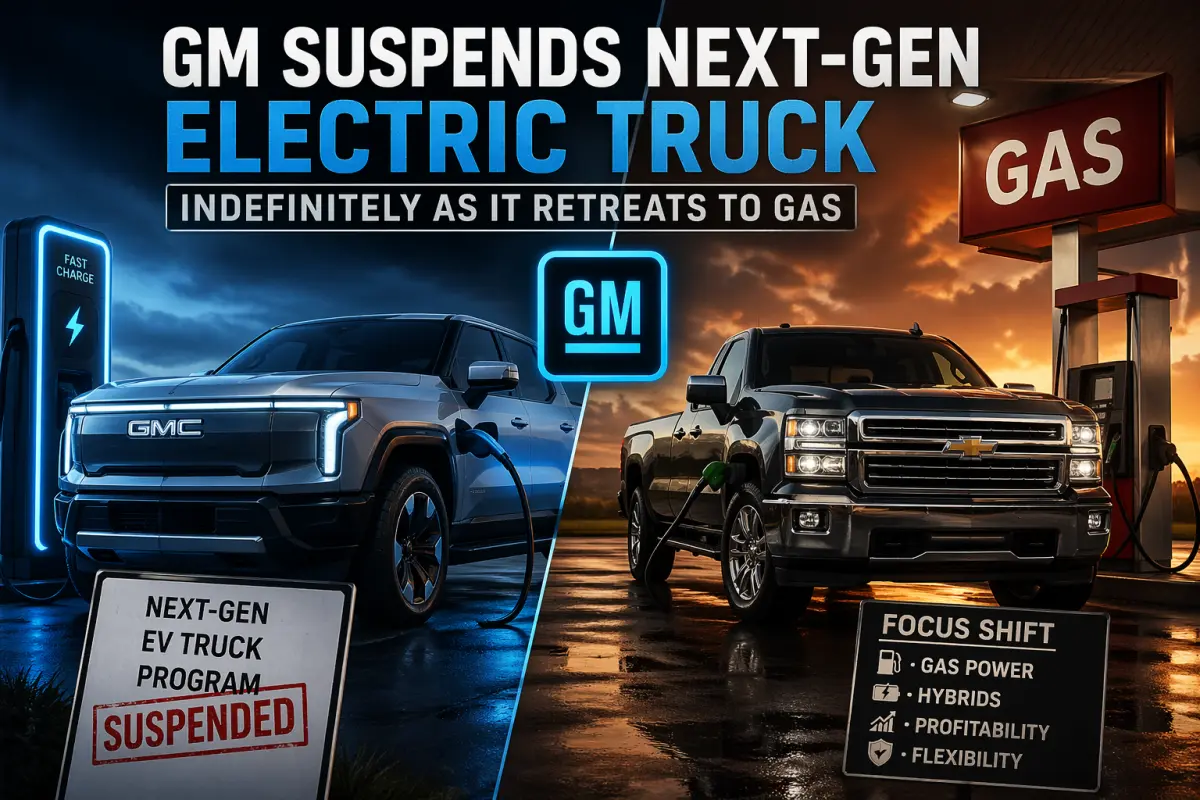
GM Halts Next-Gen EV Trucks, Returns to Gas
In a dramatic shift that underscores the growing turbulence in the electric vehicle (EV) market, General Motors (GM) has indefinitely suspended development of its next-generation electric trucks. The decision marks a notable pivot back toward gasoline-powered vehicles and hybrid technologies, raising serious questions about the pace and direction of the global transition to electric mobility.
A Sudden Pause in EV Ambitions
GM’s now-halted program was expected to deliver refreshed, more affordable versions of its flagship electric trucks and SUVs—including the Chevrolet Silverado EV, GMC Sierra EV, Cadillac Escalade IQ and Hummer EV—around 2028. However, the company has reportedly informed suppliers that the project is on hold with no revised timeline.
This indefinite delay effectively puts the future of GM’s large electric vehicles in limbo beyond their current generation. While existing EV models will continue production, the absence of next-generation upgrades signals a strategic slowdown rather than a temporary hiccup.
Why GM Is Pulling Back
The reasons behind GM’s decision are rooted in a mix of economic, political and consumer-driven factors.
1. Weak EV Demand
Despite years of hype, demand for large electric trucks has not met expectations. Sales of GM’s EV lineup have been underwhelming, with relatively low volumes compared to traditional gas-powered trucks.
In fact, the broader EV market in the United States has cooled significantly, with declining growth rates and increasing consumer hesitation around price, charging infrastructure and range anxiety.
2. Financial Losses
GM has already incurred substantial losses in its EV division. The company recorded billions in EV-related charges, including a major writedown tied to scaling back production plans and canceling supplier contracts.
Developing large electric trucks is particularly expensive due to battery costs, weight requirements and engineering complexity. These vehicles often require massive battery packs, which drive up prices and reduce profitability.
3. Policy and Incentive Changes
Government policy shifts have also played a role. The removal of EV incentives—such as the $7,500 federal tax credit in the U.S.—significantly impacted consumer demand and disrupted automakers’ projections.
Without strong policy support, the business case for scaling EV production becomes much weaker, especially in price-sensitive segments like pickup trucks.
4. Market Reality vs. Ambition
GM had previously committed to an all-electric future, even setting a goal to phase out internal combustion engines by 2035. However, the current market reality has forced a reassessment.
The company now appears to be prioritizing profitability and flexibility over aggressive electrification timelines.
The Return of Gas and Rise of Hybrids
As GM pauses its next-gen EV truck plans, it is doubling down on gasoline-powered vehicles and exploring hybrid alternatives.
Reports suggest that GM is preparing to launch plug-in hybrid versions of popular models like the Silverado and Sierra. These vehicles combine electric efficiency with the reliability and range of traditional combustion engines—making them more appealing to mainstream consumers.
Additionally, GM is considering extended-range EV systems, where a small gas engine acts as a generator to recharge the battery. This approach could bridge the gap between fully electric vehicles and conventional cars.
At the same time, the company is investing heavily in its next-generation gas-powered truck platform, including new V-8 engines and updated designs.
This pivot highlights a broader industry trend: automakers are no longer rushing headlong into full electrification but are instead adopting a more balanced, multi-powertrain strategy.
A Broader Industry Shift
GM is not alone in recalibrating its EV strategy. Several major automakers have recently scaled back their electric ambitions amid similar challenges.
For example, Ford Motor Company has also reduced its EV investments, canceled key projects and shifted focus toward hybrids and affordable electric models.
This growing trend suggests that the initial wave of EV enthusiasm may have outpaced market readiness. While long-term demand for electric vehicles remains strong, the transition is proving more complex and slower than anticipated.
The Challenge of Electric Trucks
Electric pickup trucks were once seen as the next big frontier in the EV revolution. However, they present unique challenges:
High Costs: Large batteries make them expensive to produce and buy.
Heavy Weight: Bigger vehicles require more energy, reducing efficiency.
Limited Demand: Traditional truck buyers often prioritize towing capacity, range and reliability—areas where EVs still face limitations.
These factors have made it difficult for automakers to scale production profitably, leading to cautious investment decisions like GM’s recent move.
Environmental Concerns and Criticism
GM’s decision has sparked criticism from environmental advocates, who see it as a step backward in the fight against climate change.
Electric vehicles are widely considered essential for reducing greenhouse gas emissions and achieving global climate targets. A slowdown in EV development—especially from a major player like GM—could have ripple effects across the industry.
However, some analysts argue that a temporary pause may ultimately lead to better, more affordable EVs in the future. By focusing on improving technology and reducing costs, automakers can build a stronger foundation for long-term adoption.
What This Means for Consumers
For consumers, GM’s pivot could have mixed implications:
More Choices: The rise of hybrids and gas-powered updates provides flexibility.
Slower EV Innovation: New electric truck models may take longer to arrive.
Potential Price Stability: Reduced pressure to scale EV production could prevent price volatility.
In the near term, buyers interested in electric trucks may face limited options, while those open to hybrids could benefit from new offerings.
The Road Ahead
Despite the current setback, GM insists that electric vehicles remain a core part of its long-term strategy. The company has not canceled its EV programs entirely but has instead chosen to delay and reassess.
Industry experts believe that next-generation electric trucks could still arrive—possibly after 2030—once technology improves and market conditions stabilize.
In the meantime, GM’s focus on hybrids and gas-powered vehicles reflects a pragmatic approach to navigating an uncertain market.
Conclusion
GM’s decision to suspend its next-generation electric truck program marks a pivotal moment in the evolution of the automotive industry. It highlights the gap between ambitious electrification goals and real-world challenges such as cost, demand and policy support.
Rather than signaling the end of EVs, this move represents a recalibration—a shift toward a more measured and flexible strategy. As automakers adapt to changing conditions, the future of transportation is likely to be more diverse than previously imagined, blending electric, hybrid and traditional technologies.
The electric revolution is far from over—but it may take a different road than expected.

 Facebook
 Twitter
 Whatsapp
 Linkedin